
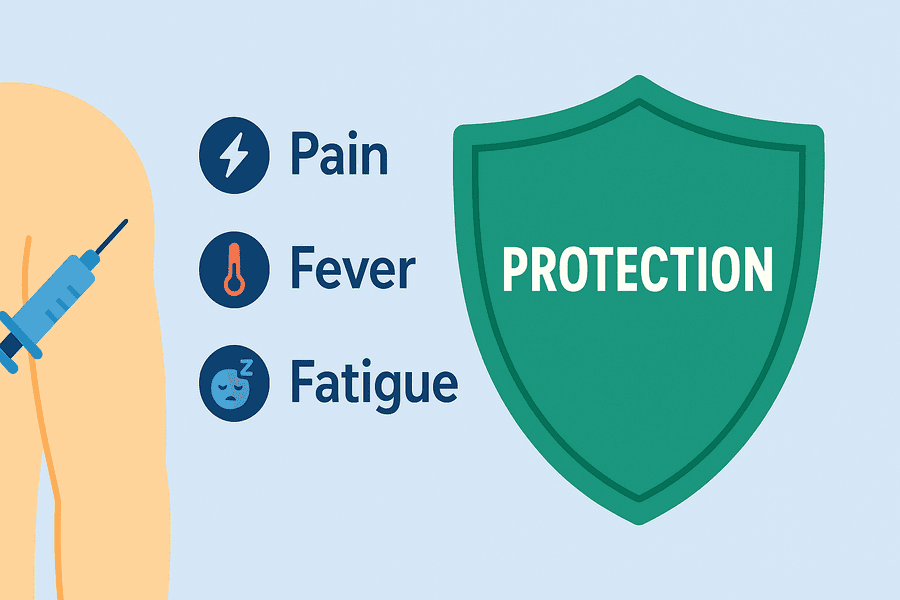
Vaccines are biological preparations that help your immune system build protection against infectious diseases. After getting a vaccine, many people notice vaccine side effects. These are normal reactions as the body’s defenses learn to recognize and fight off germs. It’s common to feel a sore arm, run a mild fever, or feel tired for a day or two. These signals show that your immune system is working—training itself to protect you in the future.
If you think of vaccine side effects as part of the immune system’s training, it’s easier to understand why they happen. This also helps explain how long vaccine ingredients stay in your body. The ingredients act as short-term messengers, giving instructions to your immune cells. The protection they trigger is what lasts.
Vaccine side effects 101: what they are, why they happen, and how long vaccines stay in your body
This section explains how side effects are grouped, tracked, and connected to the immune response. It also covers how long vaccine ingredients remain in your system.
Doctors usually sort vaccine side effects into two main types. The first type includes expected effects like local soreness and mild, short-term symptoms throughout the body. The second type is rare and can include allergic reactions or unusual immune responses. Public health officials use the term AEFI (Adverse Event Following Immunisation) for anything that happens after a vaccine, whether or not the vaccine caused it. This broad definition helps experts spot patterns without jumping to conclusions.
In the United States, the Centers for Disease Control and Prevention (CDC) keeps watch for vaccine side effects through ongoing monitoring and public information. The CDC’s Vaccine Information Statement (VIS) is a handout that explains the benefits and risks of each vaccine. It includes what side effects to expect and when to seek help. The Food and Drug Administration (FDA) checks vaccine safety in studies before approval and continues tracking side effects after vaccines are used in the real world.
Side effects happen because the immune system is responding. After a shot, immune cells spot the vaccine’s antigen and release cytokines—chemical signals that call other cells to action. This can cause warmth, redness, or swelling at the injection site. Throughout the body, the same process can lead to a brief fever, fatigue, or aches. The immune response that builds protection is also what you feel as side effects.
How long vaccine components stay in your body depends on the type of vaccine, but they don’t stick around for long:
- Messenger RNA vaccines: The mRNA enters cells inside tiny fat bubbles, tells cells to make a protein for a short time, and is then broken down within days. The fat bubbles are also quickly processed by the body.
- Non-replicating viral vector vaccines: The vector delivers instructions but doesn’t change your DNA. It’s cleared out over days to weeks.
- Protein subunit and inactivated vaccines: The proteins are taken up and destroyed by immune cells. Ingredients like aluminum salts (used as adjuvants) may stay at the injection site a bit longer but are gradually removed over weeks.
No matter the vaccine, the only part that sticks around is immune memory: antibodies and memory cells that can protect you for months or even years after the physical vaccine is long gone.
Most side effects (AEFIs) show up soon after the shot. A few rare reactions can take longer. For example, some unusual immune-related events may appear about two weeks after vaccination. This timing matches how long certain immune processes take to develop.
A very rare but serious side effect called blood clots with low platelets can happen about 10 days after some COVID-19 vaccines. If you experience unu…
Some less typical but not dangerous reactions have been observed and usually go away on their own. For example, a few people noticed temporary changes in their menstrual cycle after certain vaccines. Studies show these are short-lived physiological responses, not lasting changes.
More than half of women in the study noticed changes in their period timing, flow, or pain after the COVID-19 vaccine, but these changes lasted less t…
In short, vaccine materials themselves are gone quickly, while the protection lasts. Side effects—whether at the injection site or throughout the body—come from the same immune response that creates lasting immunity. CDC and FDA programs track these effects as AEFIs, as explained in VIS handouts and other safety updates.
What to expect after a shot: common symptoms, fatigue, and when they start
Knowing when and how typical symptoms appear can help you prepare for what comes after a vaccine.
The most frequent vaccine side effects are reactions at the injection site and fever. Local reactions—pain, redness, or swelling—happen where the shot is given. They occur because immune cells move to the area and boost blood flow. Fever is a brief rise in body temperature, part of the body’s overall immune response. Many health guides use 38 degrees Celsius as the point where fever starts.
Most people notice one or more of these in the first few days after a dose:
- Injection site reactions: tenderness, redness, warmth, or mild swelling where you got the shot.
- Fatigue: feeling tired as immune signals prompt your body to rest.
- Headache and muscle aches: mild, short-term pain caused by the immune response.
- Fever or chills: usually low and brief; clinicians often use 38 degrees Celsius as the fever mark.
- Swollen lymph nodes near the injection site: a sign that your immune system is actively processing the vaccine.
Fatigue is a common, short-lived symptom that comes with immune activation. As your body recognizes the vaccine, chemical signals may make you feel tired and encourage rest. This is a normal part of building protection.
Side effects tend to follow a predictable timeline:
- Minutes to hours: local soreness can start the same day; immediate allergic reactions are very rare but can happen within minutes.
- First 24–48 hours: symptoms like fatigue, headache, muscle aches, and low fever usually begin and improve within one to three days.
- Days to weeks: rare immune-related events, if they happen, tend to show up later. Some specific reactions may cluster around the second week after certain vaccines.
This pattern is similar for different ages and types of vaccines, with only small differences. For young children, new vaccines given as shots cause soreness or redness at rates similar to older, established vaccines. This shows that local side effects are expected and usually mild.
In young children, new vaccines given as injections were found to have similar rates of mild injection site reactions, like soreness or redness, compa…
Even when two vaccines are given at the same time—like a COVID-19 shot with the flu vaccine—local reactions stay within the expected range. This reflects normal immune activity, not extra risk.
When people received two different vaccines at the same time, the rates of local side effects like pain or swelling at the injection site were about t…
To sum up, the most common early side effects—especially injection site reactions and brief fever—are normal parts of the immune response. Fatigue is expected and short-lived. Most symptoms start within hours to two days after a shot and go away quickly. Rare events may appear later and are tracked as AEFIs. CDC’s VIS handouts explain what to expect, and FDA and CDC monitoring systems keep watch to maintain vaccine safety.
By vaccine: tetanus (Td/Tdap), HPV, and COVID-19—typical and serious reactions
This section compares common and rare side effects for several vaccines, pointing out what they share and what’s different.
Each vaccine has its own side effect profile, but some features are shared. For tetanus boosters (Td/Tdap) in adults, the most common effects are pain, redness, and swelling at the shot site. These begin within a day and fade in a few days. Mild fever, fatigue, headache, and muscle aches can also happen. Occasionally, adults who get boosters too soon can develop an Arthus-type reaction—a large swelling of the arm that goes away with cold packs and time. Very rare side effects include immediate allergic reactions (anaphylaxis) and, in rare cases, short-term nerve inflammation. Doctors reduce these risks by spacing boosters and keeping good records.
The human papillomavirus (HPV) vaccine causes a similar pattern: a sore arm, temporary redness or swelling, and mild fever or fatigue in the first 48 hours. Fainting can happen with any teen vaccine, usually because of anxiety or a reflex, not the vaccine itself. Watching teens for 15 minutes after the shot helps prevent falls. Serious side effects from the HPV vaccine are extremely rare and mainly involve immediate allergy. Careful safety checks have not found proof of long-term harm. The benefits are strong because the HPV vaccine prevents cancers.
COVID-19 vaccines protect against COVID-19 and lower the risk of severe illness and death. They train the immune system to recognize SARS‑CoV‑2. Most short-term effects—sore arm, fatigue, headache, muscle aches, and mild fever—start within 24–48 hours and clear up in two to three days. Tender lymph nodes may last up to a week. A delayed rash (“COVID arm”) can appear around day 5–10 after an mRNA vaccine and usually goes away on its own.
Rare but important side effects have been identified through global monitoring. Anaphylaxis can occur but is uncommon, and vaccine clinics are prepared to treat it. The rate is about five cases per million doses. A rare syndrome called thrombosis with thrombocytopenia (TTS) was linked to some adenoviral-vector vaccines; the risk is very low but real. Monitoring has also found rare cases of myocarditis and pericarditis with mRNA vaccines. These mostly affect adolescent and young adult males within a week of the second dose. Most cases are mild, respond to rest and anti-inflammatory medicine, and people recover fully. Doctors advise seeking help for chest pain, shortness of breath, or palpitations.
Getting a COVID-19 vaccine was linked to a higher chance of mild heart inflammation (myocarditis), especially in younger people and those who got the…
For teenagers—especially boys—the risk of myocarditis after catching COVID-2 is higher than after getting the Pfizer-BioNTech vaccine (Comirnaty). This fact underlies current advice to vaccinate, while adjusting timing to lower the small risk of myocarditis in younger males.
For teenagers, especially boys, the risk of heart inflammation (myocarditis) is actually higher if they catch COVID-19 than if they get the Pfizer vac…
For most people, COVID‑19 vaccine side effects—local and general symptoms—improve within 48–72 hours. Tender lymph nodes settle in about a week, and delayed rashes resolve in several days. If symptoms get worse after the first two days, or you notice new issues like chest pain, doctors recommend getting checked promptly.
Prevent and manage discomfort: can you take pain relievers and what else helps
There are practical ways to reduce discomfort from side effects without weakening your immune response.
Many people wonder if it’s okay to take a pain reliever before a shot. Experts generally recommend not taking medicine ahead of time, since using acetaminophen or anti-inflammatory drugs before vaccination could, in theory, blunt the early immune response. It’s better to wait and see if you have symptoms, then treat them as needed. If you already take these medicines for another reason, keep taking them as prescribed unless your doctor tells you otherwise.
Once symptoms start, simple steps can help. Cooling the area and moving your arm gently can ease pain at the injection site. Staying hydrated, resting, and light activity can help with fatigue. If you have bothersome fever or aches, you can use acetaminophen or an NSAID after the shot at standard doses, unless your doctor says not to. Avoid aspirin in children because of the risk of Reye’s syndrome. If you’re not sure what’s right for you, talk to your healthcare provider—they can give advice based on your health and the vaccine you received.
Health authorities reinforce these recommendations. Health New Zealand, for example, notes that most local reactions and mild fever clear up quickly. If a fever lasts more than 48 hours, arm swelling worsens rapidly, or you notice new symptoms like chest pain or shortness of breath, it’s time for a medical review. These time-based guidelines help you tell the difference between normal, short-lived reactions and symptoms that need attention.
Concerns and debates: why some parents hesitate, common COVID-19 complaints, and what evidence shows
This section looks at the range of worries and reports that have come up, especially during the COVID-19 pandemic, and how experts investigate them.
During the pandemic, people described many different experiences after COVID-2019 vaccination (COVID-19 is caused by SARS‑CoV‑2). The most common complaints matched the usual vaccine side effects: sore arm, fatigue, headache, mild fever, and muscle aches in the first two days. Some people noticed other symptoms—like changes in taste, brief lymph node swelling, or skin rashes—which safety systems recorded and researchers studied to see if they were likely caused by the vaccine.
Vaccine safety is tracked using several systems. The Vaccine Adverse Event Reporting System (VAERS) collects reports from anyone—public or clinicians—about anything that happens after a shot, including severe allergic reactions. VAERS, run by the CDC and FDA, acts as an early warning system, not proof of causation. If VAERS picks up a possible pattern, the Vaccine Safety Datalink (VSD) can check if the rate is actually higher than expected.
For COVID‑19 vaccines, specific complaints have included oral symptoms, short-term tingling, lasting fatigue, palpitations, and chest discomfort. Oral side effects have been observed but, when linked to the vaccine, tend to be mild and temporary.
COVID-19 vaccines sometimes caused mild mouth-related side effects like changes in taste or mouth sores, but these were not dangerous. If you are tryi…
Some parents worry more about the small chance of rare side effects than the benefits, especially if the disease seems far away. Others may be uneasy about new vaccine technologies, ingredients, or the speed of development, or prefer to rely on “natural immunity.” A few don’t trust institutions, and sometimes VAERS data is misunderstood as proof that vaccines cause every reported problem. There are also personal reasons, like religious or philosophical beliefs, or past experiences with side effects. While these concerns are varied, they all point to the need for clear information about how safety is monitored, what’s known about rare events, and when to seek medical help.
Rare and prolonged reactions: post-vaccine syndrome and when to seek care
This section covers long-lasting symptoms and rare side effects, with advice on when to get medical attention.
Post‑vaccine syndrome is a term for symptoms that start after a shot and last longer than usual. It isn’t a single diagnosis, but a group of complaints—like ongoing fatigue, “brain fog,” sleep trouble, palpitations, or symptoms similar to nervous system imbalance—that people connect to a recent vaccine. In the COVID‑19 era, some studies call this “post‑COVID‑19 vaccination syndrome.” Doctors stress the importance of checking for other causes, since many conditions—like viral infections, anemia, thyroid problems, medication effects, anxiety, or even COVID itself—can look similar.
Research on these longer-lasting symptoms shows that mental and cognitive effects are sometimes reported after COVID‑19 vaccination. Most people improve over time. While most cases resolve on their own, some people need focused rehab, better sleep, or help managing symptoms.
After getting a COVID-19 vaccine, some people report mental symptoms like fatigue, trouble concentrating, and sleep problems. These symptoms are fairl…
Rare side effects are important to spot quickly. Anaphylaxis is a sudden, severe allergic reaction that can cause hives, swelling, wheezing, or low blood pressure within minutes. Clinics keep emergency medicine on hand and watch people for a short time after vaccination. Myocarditis and pericarditis—rare inflammations of the heart or its lining—usually show up within a week, with chest pain, shortness of breath, or palpitations. Doctors use heart tests and imaging to check these, and most people recover with rest and anti-inflammatory treatment.