


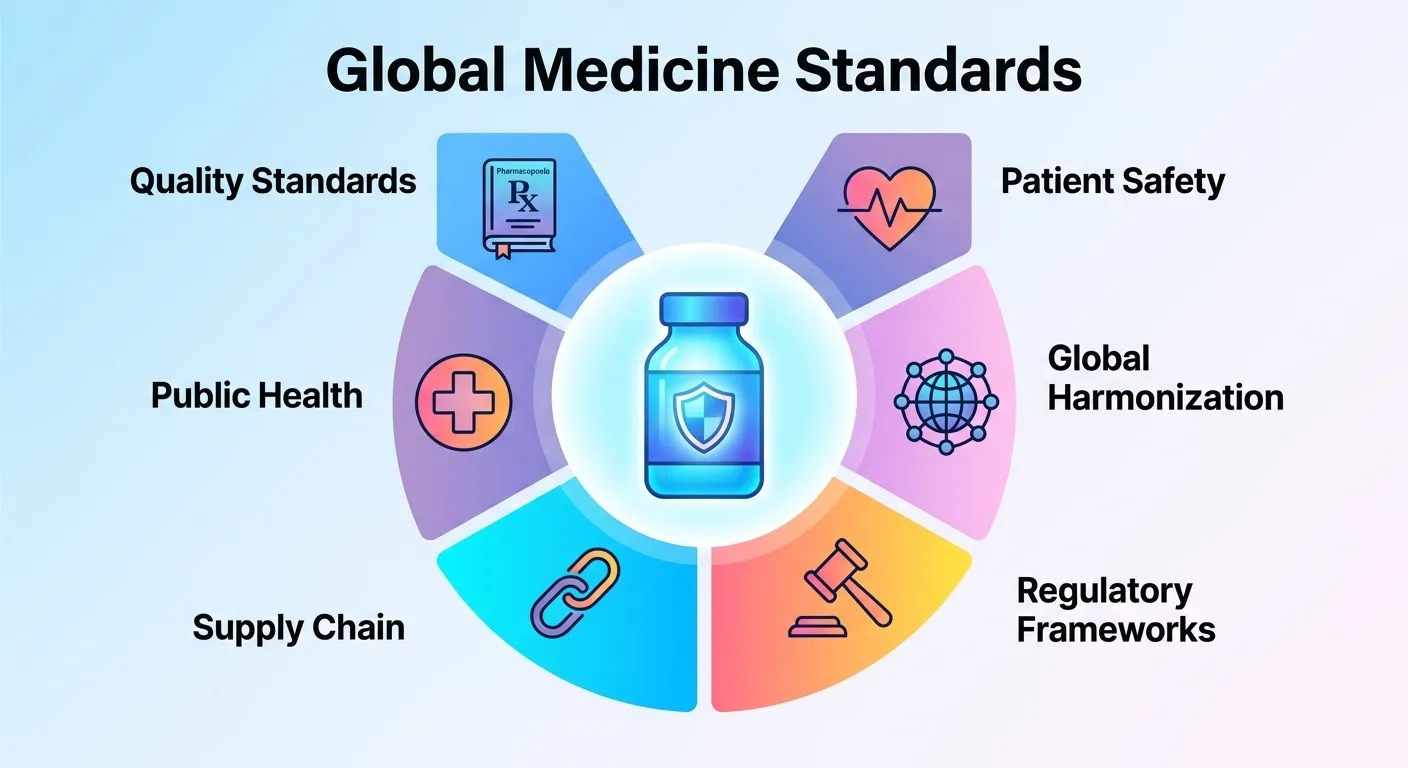
The medication in your cabinet must align precisely with its labeled specifications to ensure patient safety. Global medicine standards constitute the harmonized technical requirements and regulatory frameworks that guarantee the quality, safety, and efficacy of pharmaceuticals across international borders. These protocols facilitate mutual recognition between regulatory bodies, allowing a drug approved in one jurisdiction to meet the rigorous criteria of another without redundant testing. This systematic alignment is essential for maintaining a secure global supply chain, ensuring that life-saving treatments remain reliable and that public health protections are enforced through consistent quality assurance measures.
The World Health Organization leads this effort by establishing technical guidelines that countries use to build their own health systems. Alongside them, the International Council for Harmonisation of Technical Requirements for Pharmaceuticals for Human Use works to align these requirements across borders. A drug developed in one region must meet the same high expectations in another. That’s a massive undertaking.
What global medicine standards are and why they matter?
Approximately 10% of medical products in low- and middle-income countries fail to meet required specifications, highlighting a stark disparity in pharmaceutical integrity across regions (1). To mitigate these risks, pharmacopoeias establish public quality standards that define the identity, strength, and purity of therapeutic agents. The United States Pharmacopeia-National Formulary maintains over 5,000 monographs for active ingredients and finished products, while the European Pharmacopoeia provides a legal framework for quality control across Europe (2). Since 1989, the Pharmacopoeial Discussion Group has worked to align these disparate technical requirements and streamline international manufacturing (3). These standards directly protect patients—the 10% substandard product rate in low- and middle-income countries illustrates the danger inherent in weak regulatory oversight.
Consequences of substandard and falsified medicines
Data cited by the WHO indicate that between 72,000 and 169,000 children die annually from pneumonia because they receive substandard or falsified antibiotics (1). These therapeutic failures extend further: research published in the American Journal of Tropical Medicine and Hygiene estimates that falsified antimalarials contribute to roughly 116,000 additional deaths each year in sub-Saharan Africa. Such tragedies are not new. In 1937, the Elixir Sulfanilamide disaster caused 107 deaths in the United States after a manufacturer used toxic diethylene glycol as a solvent (4)—an event that historically catalyzed the demand for stricter safety testing and oversight. Patient safety requires continuous vigilance.
- Childhood mortality: Ineffective pneumonia and malaria treatments lead to hundreds of thousands of preventable deaths in vulnerable populations.
- Chemical contamination: The use of industrial solvents in place of safe excipients can lead to mass poisoning events.
- Regulatory frameworks: The Falsified Medicines Directive introduced mandatory safety features and verification systems for products in the European Union.
- Implementation milestones: New safety requirements under the Falsified Medicines Directive became fully applicable in early 2019 to secure the legal supply chain (5).
Modern enforcement relies on these structured legal requirements to prevent dangerous products from infiltrating pharmacies. Robust standards remain the primary defense against the recurrence of historical pharmaceutical tragedies.
Key global regulatory bodies and their roles
Global pharmaceutical oversight functions through a dense network of national and international organizations that must coordinate to manage complex distribution and logistics networks. These authorities collaborate by sharing technical data and aligning their inspection protocols — a cooperative framework that relies on specialized groups to bridge regional gaps.
- International Coalition of Medicines Regulatory Authorities
- The International Coalition of Medicines Regulatory Authorities provides strategic leadership for executive-level regulators to address shared global challenges and emergency responses.
- International Pharmaceutical Regulators Programme
- The International Pharmaceutical Regulators Programme was launched on 1 January 2018 to consolidate previous international forums and facilitate a venue for regulators to exchange information on pharmaceutical products and regulatory issues. It serves as a central hub for harmonizing technical requirements for medicinal products for human use.
- Access Consortium
- A work-sharing initiative between authorities like the Medicines and Healthcare products Regulatory Agency and the Swiss Agency for Therapeutic Products to speed up patient access to medicines.
- Health Sciences Authority
- The Health Sciences Authority is the national regulator for Singapore that participates in international work-sharing to optimize resource use and safety monitoring.
- International Federation of Pharmaceutical Manufacturers and Associations
- The International Federation of Pharmaceutical Manufacturers and Associations represents the research-based industry globally and engages with regulators to support high-standard policy development.
This collaborative framework facilitates work-sharing initiatives among Access Consortium members, which has effectively reduced review timelines through joint assessments. Such coordination, bolstered by the strategic alignment of ICMRA, streamlines global responses to public health crises by synchronizing regulatory decisions across multiple jurisdictions.
Globally, national oversight agencies span every continent, including Health Canada (Canada), Swissmedic (Switzerland), the Medicines and Healthcare products Regulatory Agency (UK), the National Medical Products Administration (China), the Central Drugs Standard Control Organization (India), the Ministry of Food and Drug Safety (South Korea), the Therapeutic Goods Administration (Australia), the South African Health Products Regulatory Authority, the National Health Surveillance Agency (Brazil), and the Federal Commission for Protection against Health Risks (Mexico). These agencies maintain regional standards and frequently share data and inspection results to streamline the approval of life-saving therapies.
ICH, WHO, and PIC/S: harmonizing international standards
Manufacturers benefit significantly when they can follow a single set of technical expectations rather than navigating conflicting requirements for every country they serve. The International Council for Harmonisation plays a central role here, developing unified technical requirements for pharmaceutical registration that reduce the need for duplicate clinical trials and laboratory testing across jurisdictions.
The International Council for Harmonisation (ICH) develops unified guidelines for pharmaceutical regulation, supporting global convergence and reducing duplication of regulatory efforts.
Standardization also extends to the physical production environment through PIC/S. This organization focuses on the inspection process, ensuring that Good Manufacturing Practice standards are applied consistently by its 56 Participating Authorities (6). Widespread adoption matters here. An inspection by one member is often respected by others, so quality remains high regardless of where a medicine is produced.
FDA, EMA, and PMDA: major national and regional authorities
Regional gatekeepers serve as the final authority for determining which medicines may enter their local markets. These agencies evaluate scientific data to confirm that any new drug is safe and effective for the public. They operate independently, yet they regularly share information to protect patient health across borders.
- FDA: Oversees the United States market, enforcing rigorous safety and efficacy standards for all pharmaceutical products.
- EMA: Began its operations in the mid-1990s to provide a centralized pathway for medicine evaluation across the European Union (7).
- PMDA: Japan’s primary agency, which came into service in 2004 to manage drug reviews, safety monitoring, and compensation for adverse effects (8).
Each agency maintains its own specific legal mandate while striving for alignment with global standards. Local patient needs are met without isolating the region from international medical advancements.
These agencies are empowered by legal frameworks such as the US Food, Drug, and Cosmetic Act, the Official Journal of the European Union directives, and global resolutions like World Health Assembly Resolution WHA67.20, which provides a framework for strengthening national regulatory systems to ensure medical products are of high quality.
WHO prequalification programme and the 10th Edition Quality Assurance Guidelines?
Universal standards for pharmaceutical quality are often defined by the WHO Pharmaceutical Quality Assurance 10th Edition Guidelines — documents that provide a comprehensive framework for everything from risk management to validation protocols. Many countries use them as the foundation for their own domestic regulatory systems.
The WHO prequalification programme, established in 2001, applies these standards to medicines for priority diseases like HIV and malaria (9). By verifying that specific products meet unified criteria, the program allows international procurement agencies to purchase medicines with confidence. It is a direct link between rigorous quality standards and global access to life-saving treatments.
Good Manufacturing Practice and pharmaceutical quality standards
Good Manufacturing Practice is the essential system designed to minimize the risks inherent in pharmaceutical production — risks that cannot be eliminated through testing the final product alone. It covers all aspects of production: starting materials, premises, and equipment, down to the training and personal hygiene of staff. Three requirements anchor the whole framework.
- Manufacturers must establish a comprehensive Quality Management System to oversee all manufacturing stages.
- Facilities must maintain clean and controlled environments to prevent environmental contamination.
- Manufacturers must implement strictly defined and validated processes for every batch produced.
Adherence to these rigorous GMP frameworks ensures that every batch remains compliant as the product transitions from the manufacturing floor into the formal regulatory approval pathways required for market access.
Process validation and cleaning validation in manufacturing
Imagine a production line that must switch from manufacturing a high-potency cardiovascular drug to a standard antibiotic without leaving a single trace of the previous substance. That requirement makes validation non-negotiable. Process Validation provides documented evidence that a specific procedure will consistently yield a product meeting its predetermined quality specifications. It is a proactive approach — not a retrospective check.
Cleaning Validation complements this by verifying that the cleaning procedures used between batches effectively remove residues of active ingredients and detergents, guarding against cross-contamination that threatens patient health. Rigorous testing ensures subsequent products are not compromised by leftover materials. Ultimately, these validation protocols safeguard the patient by ensuring that the medicine they receive is exactly what the label claims, free from unintended chemical interference.
Health-based exposure limits and cross-contamination prevention
Unintended chemical transfer during manufacturing can cause severe adverse reactions or reduce a drug’s efficacy. To manage these hazards, manufacturers use Health-Based Exposure Limits to determine the maximum safe amount of a substance that can remain on equipment after cleaning. These limits are derived from toxicological data. They give facilities a scientific, quantitative basis for proving that their cleaning cycles protect the next batch of medicine.
Regulatory bodies enforce strict separation for certain high-risk substances to further mitigate these dangers. For example, 21 CFR 211.42(d) mandates that the manufacturing and processing of penicillin for human use must occur in facilities entirely separate from other drug products (10) — a rule that exists to prevent life-threatening allergic reactions. Such mandates reflect a global commitment to zero-tolerance policies regarding the mixing of incompatible drug classes within the same production environment.
- If a substance has a high sensitizing potential (like penicillin):
- Utilize dedicated, self-contained facilities and separate air handling systems.
- If a substance is non-sensitizing but potent:
- Apply Health-Based Exposure Limits to validate cleaning and allow for shared equipment use.
Documentation, traceability, and Good Distribution Practice?
A comprehensive record must exist for every chemical component and every mechanical adjustment made during the creation of a drug. This paper or digital trail is the foundation of accountability. Accurate documentation ensures that every batch is fully traceable from the raw material supplier to the pharmacy shelf — and if a defect is discovered, that system enables a rapid, precise recall. Granular batch traceability allows for targeted recalls that significantly limit patient exposure compared to broad market withdrawals.
Once a product leaves the factory, Good Distribution Practice takes over to maintain the integrity established by manufacturing standards. These guidelines ensure that medicines are stored, transported, and handled under conditions that preserve their quality and identity.
- Batch Recording: Capturing real-time data during production to create a permanent history of the lot.
- Logistics Oversight: Monitoring temperature and humidity during transit to prevent degradation.
- Inventory Control: Managing the supply chain to ensure that only authentic, unexpired products reach the consumer.
Maintaining this chain of custody is essential for meeting regulatory requirements and protecting the public from substandard or falsified medicines.
Regulatory approval processes for new medicines
Rigorous evaluation frameworks ensure that every therapeutic agent undergoes a systematic review of its safety and efficacy before it can be legally marketed. This structured journey relies on the ICH M4 Common Technical Document, which provides a unified format for submitting clinical and non-clinical data to authorities. By adhering to ICH E6 Good Clinical Practice, sponsors maintain ethical and scientific standards during human trials — protocols that verify the data supporting a drug application is both credible and accurate. Regional agencies then manage these pathways through distinct frameworks, before turning to how they monitor safety once products enter the market. Notably, the premarket evaluation typically follows a clinical development phase averaging six to seven years, during which exhaustive dossiers detail chemical stability and manufacturing consistency, ensuring only products with a proven benefit-risk profile reach the public.
Approval pathways at the US FDA, EU EMA, and Japan PMDA
Regulatory bodies across the globe maintain distinct timelines and procedural requirements for evaluating pharmaceutical submissions. The underlying scientific data stays consistent. The administrative milestones for reaching a final decision, however, vary significantly between major jurisdictions.
- FDA
- The agency has 60 days to file an application for review, with a 10-month goal for standard reviews and a six-month target for priority status.
- EMA
- The Committee for Medicinal Products for Human Use conducts a scientific assessment over 210 active days, followed by a 67-day period for the European Commission to issue a formal decision. The EMA manages four distinct approval pathways: the Centralized Procedure (single application for all EU countries), National Procedure (for one country), Decentralized Procedure, and Mutual Recognition Procedure (for coordination among multiple national authorities).
- PMDA
- Japan sets a total target review time of 12 months for standard products and reduces this window to nine months for medicines granted priority review.
Coordination between these agencies can reduce the time between regulatory submission and patient access to new treatments. Clear pathways remain fundamental for ensuring global access to life-saving medicines.
Regulatory inspections and compliance verification
Maintaining high standards across the pharmaceutical landscape requires continuous monitoring of facilities and internal quality systems. Independent audits verify that manufacturers adhere to established protocols during the production and testing of medicinal products. The WHO Global Benchmarking Tool provides an objective framework for this process, evaluating regulatory authorities against more than 260 specific indicators to determine their maturity level. Regulatory enforcement actions following inspections may include classifications such as No Action Indicated (no significant deviations), Voluntary Action Indicated (minor violations requiring correction), or Official Action Indicated (serious risks potentially leading to recalls or penalties).
- Authorities conduct pre-approval inspections to verify the authenticity of data submitted in marketing applications.
- Regulators perform routine surveillance audits of manufacturing sites to ensure ongoing adherence to quality standards.
- The WHO conducts systematic benchmarking of national regulators to strengthen global health security and oversight.
In early 2022, the Health Sciences Authority (HSA) of Singapore became the first national agency to achieve Maturity Level 4 (ML4)—the highest rank under the WHO Global Benchmarking Tool (GBT). This milestone, formally announced by the World Health Organization in March 2022, provides independent verification that the regulatory system is operating at an advanced level of performance and remains robust enough to ensure patient safety.
When a medicine fails to meet standards: corrective actions?
Failure to satisfy established quality or safety criteria triggers immediate administrative and technical responses. Regulatory frameworks mandate that any drug product failing to meet its specifications must be rejected before it reaches the consumer. The quality control unit plays a central role. Every unexplained failure requires a thorough investigation to identify the root cause and prevent recurrence. Post-approval change management is also crucial, as it documents and approves modifications to a drug’s manufacturing, labeling, or distribution after market entry.
- Product Rejection: Any batch that does not comply with established standards is barred from distribution.
- Root Cause Investigation: Manufacturers must document and analyze any discrepancy to determine if other lots are affected.
- Reprocessing Protocols: Strict quality control review is required before any material can be re-entered into the production flow.
- Field Alert Reporting: Authorities must be notified within 3 working days of discovering certain significant product failures.
These corrective actions are fundamental to maintaining the integrity of the pharmaceutical supply chain. Swift intervention ensures that patient safety remains the primary focus of the regulatory process. Post-market surveillance further safeguards patients by utilizing electronic databases and reporting systems—such as the FDA’s Sentinel Initiative and the Vaccine Adverse Event Reporting System—to track real-world product performance and rapidly identify safety signals that may not have emerged during clinical trials.
Post-market surveillance and pharmacovigilance
Approval is not the finish line. Maintaining the safety of a medicinal product requires rigorous observation that extends far beyond the initial clinical trial phase. Pharmacovigilance serves as the primary mechanism for detecting previously unrecognized side effects or long-term complications once a drug enters widespread use. By systematically collecting and evaluating data from real-world clinical settings, regulatory bodies can implement rapid interventions to prevent medication-related harm. This ongoing scrutiny is a foundation of global medicine standards, ensuring that the risk-benefit profile of a therapy remains favorable throughout its lifecycle. Notably, real-time data monitoring by agencies such as the EMA and FDA has enabled the rapid identification of rare safety issues, such as thrombotic events linked to certain COVID-19 vaccines, leading to immediate label updates and age-specific clinical guidance.
“Post-market surveillance and pharmacovigilance are integral to global medicine standards for ongoing patient safety.”
Global pharmacovigilance systems and adverse event reporting
Coordinating the collection of safety data across international borders ensures that rare or delayed reactions are identified quickly. The WHO Programme for International Drug Monitoring, established in 1968, provides the foundational framework for this collaborative effort. Since 1978, the Uppsala Monitoring Centre has managed the technical operations of this initiative, supporting more than 180 member countries in their surveillance duties (WHO, 2023). Central to this network is VigiBase — a massive global database that aggregates reports of suspected adverse reactions from diverse populations. In the United States, the FDA’s Sentinel Initiative proactively monitors medical product safety by querying diverse healthcare data sources, while the Vaccine Adverse Event Reporting System (VAERS) specializes in collecting and analyzing reports of health problems following vaccination.
International data sharing remains a critical tool for public health. By pooling information, scientists can detect safety signals that would never surface within a single nation’s data set.
Medication errors: reporting and root cause analysis
Systematic documentation of clinical mistakes is essential for building a healthcare environment that prioritizes patient protection over individual blame. When errors occur, health professionals use specific tools to alert authorities and trigger a formal investigation. In the United States, the FAERS database serves as the primary repository for these reports, capturing detailed accounts of medication errors and adverse events. Reporters often use the MedWatch system, which requires a comprehensive description of the event, the personnel involved, and the specific product details to facilitate a thorough review.
- Identify the immediate event and any contributing environmental factors.
- Examine the sequence of actions to determine where the protocol deviated from the standard.
- Implement corrective actions to modify the system and prevent the error from recurring.
Learning from documented failures is the only way to develop more effective clinical protocols. Individual errors become institutional knowledge. That shift is the point.
Continuous improvement and risk-based inspection planning
Vigilance must be paired with refining safety processes as new data becomes available. The ICH Q10 model provides a structured pharmaceutical quality system that emphasizes continual improvement as a core objective — encouraging manufacturers to move beyond mere compliance and seek ways to enhance product reliability. Similarly, regulatory agencies like the EMA use risk-based planning for inspections, allowing inspectors to prioritize facilities based on intrinsic product risks and the manufacturer’s previous compliance history. After a product is on the market, post-approval change management ensures that any modifications to manufacturing, labeling, or distribution are formally documented and approved. Regulatory enforcement actions may include unannounced inspections, with facilities classified as No Action Indicated, Voluntary Action Indicated, or Official Action Indicated based on inspection outcomes and compliance with safety standards.
This keeps the industry responsive to technological shifts. Integrating continuous improvement into daily operations is a primary shield for patient protection.
How global medicine standards protect patients?
Patient safety depends fundamentally on a rigorous framework of international benchmarks that guarantee the quality and availability of therapeutic agents. Since 1951, The International Pharmacopoeia has provided essential technical specifications for pharmaceutical substances and dosage forms, with the 11th edition released in 2023. These quality requirements work alongside the WHO Model List of Essential Medicines — originally established in 1977 with 208 entries and formally reviewed every two years to incorporate clinical advancements — to prioritize the most effective treatments for public health needs. By aligning national procurement with these evidence-based tools, healthcare systems ensure that populations receive safe, high-quality interventions. The continuous refinement of these standards reflects a global dedication to shielding patients from substandard or ineffective treatments as medical science progresses.
Personnel training and qualification across the supply chain
Qualified individuals serve as the primary defense against errors that could compromise the integrity of the medical supply chain. Every person involved in the handling or manufacturing of drug products must undergo rigorous instruction to meet regulatory expectations. Under 21 CFR § 211.25(a), personnel must be specifically trained in their assigned operations and the current principles of GMP to ensure consistent product quality. This educational requirement extends across several critical roles:
- Manufacturing technicians who must execute precise processing and packing protocols to avoid contamination.
- Quality control analysts are responsible for verifying that every batch meets established chemical and physical specifications.
- Warehouse and distribution staff manage environmental controls and storage conditions to prevent degradation.
Ongoing assessment of staff competency ensures that theoretical knowledge translates into practical vigilance. When employees deeply understand the “why” behind safety protocols, they are better equipped to identify and mitigate risks before they reach the consumer. To maintain compliance, 21 CFR § 211.25(a) mandates that this training and experience be documented in written records to verify that personnel can perform their assigned functions.
Adapting standards as new risks and technologies emerge
Innovation in pharmaceutical development demands a regulatory landscape that can anticipate and mitigate the challenges of modern manufacturing. Global authorities frequently update their frameworks to integrate sophisticated methodologies and digital oversight — ensuring that patient protection remains robust even as the methods of production and testing undergo fundamental shifts.
- Continuous manufacturing: ICH Q13, adopted in late 2022, provides the technical foundation for moving away from traditional batch processing toward integrated, real-time production systems.
- Analytical procedure development: ICH Q14 was established in late 2023 to improve the design and validation of the testing methods used to confirm drug purity.
- Clinical practice principles: ICH E6(R3) was updated in early 2025 to modernize the conduct of clinical trials, ensuring participant safety and data reliability in increasingly complex study environments.
The ICH Assembly oversees this iterative revision cycle, typically updating guidelines every five to ten years to reflect evolving methodologies. By formalizing these technical advancements into harmonized regulatory frameworks, the ICH ensures that global medicine standards remain a robust safeguard for patient safety and data integrity.
Sources
- World Health Organization. News release, “1 in 10 medical products in developing countries is substandard or falsified.”
https://www.who.int/news/item/28-11-2017-1-in-10-medical-products-in-developing-countries-is-substandard-or-falsified - usp.org. U.
https://www.usp.org/about/public-policy/safeguarding-pharmaceutical-supply-chains - European Directorate for the Quality of Medicines. & HealthCare, “Pharmacopoeial Harmonisation” (1989).
https://www.edqm.eu/en/pharmacopoeial-harmonisation - fda.gov. U (1937).
https://www.fda.gov/about-fda/fda-history/milestones-us-food-and-drug-law - European Medicines Agency. “New safety features for medicines sold in the EU” (2019).
https://www.ema.europa.eu/en/news/new-safety-features-medicines-sold-eu - Pharmaceutical Inspection Co. -operation Scheme, “Introduction”.
https://picscheme.org/en/about-introduction - European Medicines Agency. “EMA celebrates 30 years of progress in science and medicines in the European Union.”
https://www.ema.europa.eu/en/news/ema-celebrates-30-years-progress-science-medicines-european-union - Pharmaceuticals and Medical Devices Agency. “History” (2004).
https://www.pmda.go.jp/english/about-pmda/outline/0002.html - World Health Organization. Fact sheet, “Prequalification of health products” (2001).
https://www.who.int/news-room/fact-sheets/detail/prequalification-of-medicines-by-who - Electronic Code of Federal Regulations. 21 CFR 211.
https://www.ecfr.gov/current/title-21/chapter-I/subchapter-C/part-211/subpart-C/section-211.42
F.A.Q
What are global medicine standards?
Global medicine standards define technical rules and regulatory systems that ensure pharmaceuticals are safe, effective, and high-quality regardless of where they are produced or sold.
Why are global medicine standards important for patient safety?
By blocking substandard and fake medicines from reaching patients, these standards reduce the risk of ineffective treatments, chemical contamination, and preventable deaths.
Who sets and maintains these international medicine standards?
Organizations such as the World Health Organization, the International Council for Harmonisation, and national pharmacopoeias like the United States Pharmacopeia and European Pharmacopoeia develop and maintain these standards.
How do global medicine standards help with international drug supply?
Regulators can recognize each other’s approvals, allowing a drug cleared in one region to meet the requirements of another without repeating tests. This helps secure the global supply chain.
What happens if medicines don’t meet global standards?
Medicines that fail to meet standards may be ineffective or dangerous. They can cause preventable deaths, particularly among vulnerable groups, and sometimes result in mass poisoning from contamination.
How are pharmaceutical staff trained to maintain medicine quality?
Thorough training in good manufacturing practices is required for those in manufacturing, quality control, and distribution. Skills are regularly assessed and documented.
How do global standards adapt to new risks and technologies?
Regulatory frameworks are updated regularly to reflect new manufacturing techniques, testing methods, and clinical trial rules, ensuring patient safety as technology advances.
