


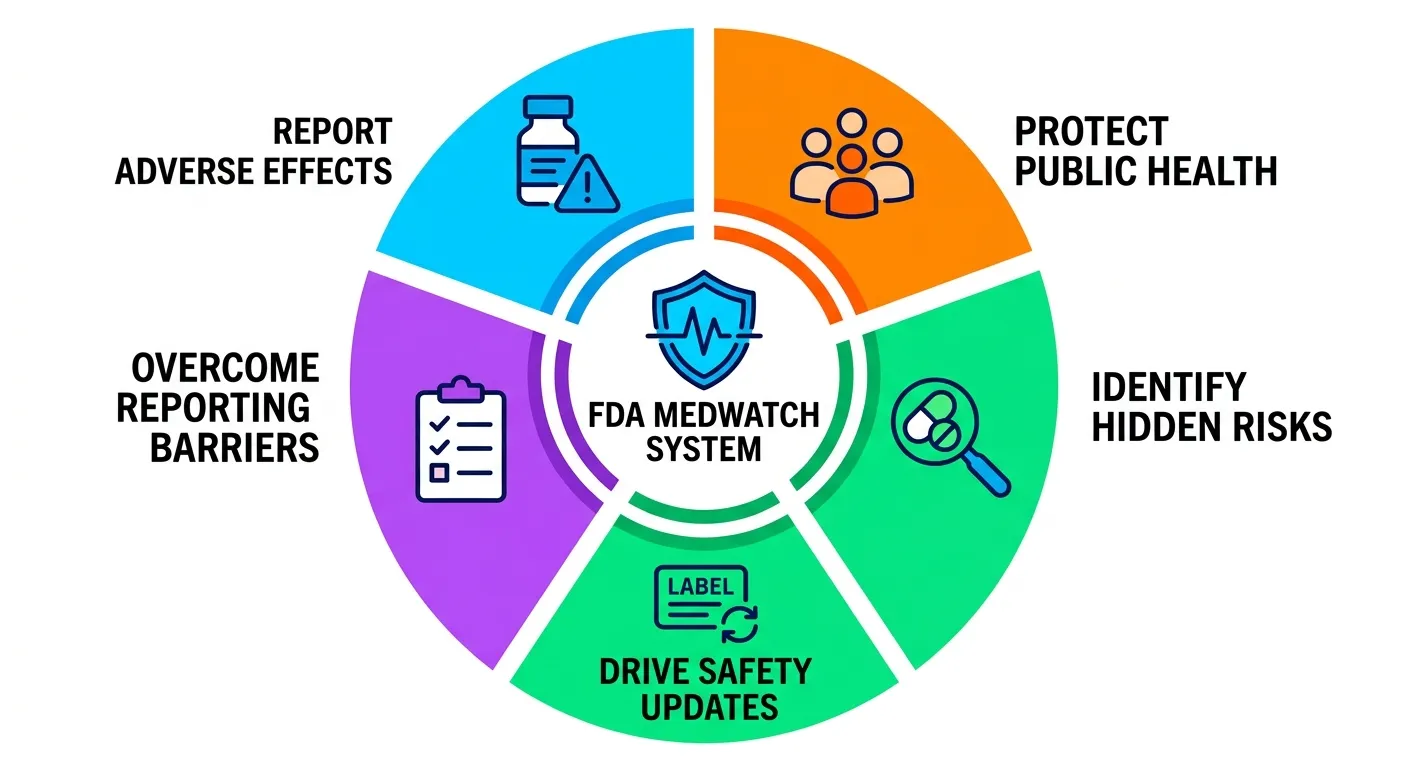
Reporting side effects helps protect your community and family. When you experience an unexpected reaction to a product, you can alert the U.S. Food and Drug Administration through a specialized system known as FDA MedWatch. This official program is the primary gateway for submitting reports about adverse effects or quality defects in the United States — the direct line to regulators responsible for monitoring the market. Every year, more than 2 million reports flow into this system from patients and healthcare providers alike (1). These submissions provide the data needed for identifying hidden risks.
The impact of these reports is tangible. For instance, consumer submissions to FDA MedWatch regarding severe liver injury were instrumental in the agency’s decision to add a Boxed Warning to the smoking cessation drug Chantix (varenicline). By documenting individual experiences, the public helps regulators identify patterns that clinical trials might miss, directly resulting in updated warning labels, safety communications, or even product withdrawals. These contributions transform personal observations into critical data points that strengthen the entire national safety infrastructure.
What FDA MedWatch is and why patient reports matter?
Safety rules can change because a single person reported an unexpected reaction. This grassroots reporting mechanism began in 1993, when FDA Commissioner David Kessler established a formalized system to streamline how the agency identifies serious adverse events and product quality defects (2). Centralizing these observations transformed the program from a passive collection of data into an active tool for clinical evaluation.
That shift deepened in 1999 when the agency released “Managing the Risks from Medical Product Use: Creating a Risk Management Framework” — a document that established strategies for reducing harm by treating medical safety as a continuous cycle of monitoring and intervention (3).
The healthcare system relies on the vigilance of both providers and patients to identify risks that clinical trials, due to their limited size and duration, might never reveal.
The impact of these reports is demonstrated by the 2020 withdrawal of Belviq (lorcaserin) after FDA analysis of post-marketing safety data revealed an increased risk of cancer. Similarly, patient-reported instances of severe liver injury led to the addition of a Boxed Warning for the multiple sclerosis drug Zinbryta before its eventual global market exit. These regulatory actions highlight how the MedWatch system transforms individual adverse event reports into decisive public health interventions that prevent further patient harm.
When patients or providers submit reports through MedWatch, the information is incorporated into the FDA Adverse Event Reporting System (FAERS), the nation’s primary database for medication errors and adverse events. MedWatch requires a comprehensive description of the event, the personnel involved, and the specific product details to ensure a thorough review. Systematic documentation and analysis of these reports allow authorities to identify root causes, implement corrective actions, and foster institutional learning that strengthens patient safety over time.
Why so many side effects go unreported?
Research indicates that many adverse drug reactions never reach federal databases. A 2023 systematic review of 13 patient-focused studies published in the International Journal of Clinical Pharmacy found that specific psychological and practical barriers frequently prevent people from sharing their experiences (4). Some patients simply do not know how to report. Others struggle to determine which specific medication caused their symptoms. This gap weakens the overall safety net, delaying the identification of real risks.
- Ignorance: Many individuals are unaware that a reporting system exists for public use.
- Complacency: A belief that the drug is already proven safe leads patients to dismiss new symptoms.
- Lethargy: The perceived effort required to document and submit a report often discourages participation.
Institutional culture also affects these statistics, as healthcare facilities that adopt a Just Culture framework—where errors are viewed as opportunities for system improvement rather than individual failures—frequently observe increased reporting rates. By mitigating the fear of punitive action, such environments encourage safety data to flow more freely to the necessary authorities. Continuous improvement and risk-based inspection planning, as promoted by global medicine standards, further reinforce the importance of ongoing vigilance and adaptation in patient safety practices.
Role of ISMP, CDC, and NIH Office of Dietary Supplements alongside MedWatch
Three organizations complement MedWatch: ISMP for medication errors, NIH ODS for supplements, and CDC for population-level surveillance. These specialized entities work with federal regulators to cover every product type, supplying the technical expertise and public outreach required to monitor high-risk medications and everyday vitamins across the national healthcare landscape.
- Institute of Safe Medication Practices
- This organization focuses on preventing medication errors by promoting best practices and collaborating with federal agencies to improve labeling and packaging safety.
- NIH Office of Dietary Supplements
- As the primary authority on non-drug supplements, this office provides the scientific evidence needed to evaluate adverse events related to vitamins and minerals.
- CDC
- The agency supports broad public health monitoring and coordinates with other bodies to track the spread of safety issues across the general population.
What qualifies as a reportable adverse event?
Defining a reportable adverse event involves identifying any undesirable experience associated with a medical product, regardless of whether you can prove the product was the definitive culprit. You are not required to establish a confirmed link between the substance and the reaction before submitting a notification — suspicion of a connection is sufficient to initiate the process. This low threshold ensures that potential risks are flagged early, allowing experts to determine whether a wider problem exists within the healthcare landscape.
Reporting a serious adverse event serves a vital function in public health by highlighting risks that may not have appeared during initial clinical trials. These submissions can expose previously unknown drug-drug interactions or reveal serious safety issues. Beyond physiological reactions, the scope of reporting includes several specific categories:
- Adverse Drug Reaction: Any unexpected or unintended response to a medication.
- Medication Error: Mistakes in prescribing, dispensing, or administering a drug that could lead to harm.
- Product Quality Issues: Concerns regarding contamination, poor packaging, or therapeutic failure.
Which products MedWatch covers – and which require a different pathway?
Certain categories of health products fall outside the primary MedWatch system, requiring you to use other channels. The Center for Drug Evaluation and Research and the Center for Biologics Evaluation and Research oversee most pharmaceuticals and biological products, but items like vaccines and tobacco use specialized portals. Knowing these distinctions ensures your data reaches the correct experts. The Center for Devices and Radiological Health, for instance, monitors technical failures through specific frameworks — and the Medical Device Reporting regulation mandates that incidents involving equipment are tracked via the MAUDE database, a repository refreshed monthly to incorporate the most recent submissions regarding device malfunctions or injuries.
The Center for Food Safety and Applied Nutrition handles its own set of unique reporting requirements for food-related concerns. Finding the right agency prevents delays in the safety review process.
When to use MedWatch specifically for supplement side effects?
Legal mandates established by the Dietary Supplement and Nonprescription Drug Consumer Protection Act require manufacturers to disclose any life-threatening or severe incidents to the government (5). As a consumer, you have the choice to submit your own report through either MedWatch or the CFSAN Adverse Event Reporting System. Supplement side effects are defined as any harmful or unintended responses occurring after the consumption of a dietary product, including vitamins and herbal extracts. These reports matter because supplements do not undergo the same pre-market approval process as prescription medications. Submitting these details helps the FDA monitor product safety and hold companies accountable for the products they sell.
Information to gather before you file a report
Gathering details ahead of time allows you to complete your MedWatch report without stopping to hunt for missing documents. The FDA requires three fundamental pieces of information — the specific name of the drug, a clear account of the adverse event, and your own contact details — but providing a more complete report is highly encouraged. You should be prepared to share the patient’s initials, weight, and race or ethnicity to help regulators identify demographic patterns.
The agency also requests a comprehensive health background, including existing medical conditions, known allergies, and tobacco or alcohol habits. If the patient is pregnant, note that alongside a full list of current medications, vitamins, and herbal supplements. Finally, specify the outcome: whether the event resulted in a disability, a birth defect, a life-threatening situation, or required hospitalization.
Product details, patient information, and reaction description
Organizing your product information is the most time-consuming part of the preparation. You will need the product name and strength, along with the NDC number or a Unique ID found on the packaging. Locate the manufacturer, the specific lot number, and the expiration date. You must also provide the exact dose, how often it was taken, the route of administration, and the start and stop dates for the therapy.
- Product Identifiers
- Specific codes like the NDC number and lot numbers that allow the Division of Drug Information to trace the exact batch of the medication.
- Event Narrative
- A detailed account of what happened, how it occurred, and the date the problem started, utilizing the 4,000 characters provided on the form.
Stay objective when you describe the reaction. The Division of Drug Information relies on these descriptions to spot safety issues across the country.
Which form applies to you: 3500, 3500A, or 3500B?
Selecting the appropriate document depends entirely on your professional role and the nature of the product you are reporting. The FDA provides different versions of the form to streamline data collection for different groups.
- If you are a healthcare professional, patient, or consumer submitting a voluntary report:
- Use Form FDA 3500 for general voluntary reporting.
- Use Form FDA 3500B if you prefer a simplified, consumer-friendly version of the voluntary form.
- If you are a researcher or work for a manufacturer:
- Use Form FDA 3500A for all mandatory reporting requirements, including those for cosmetics under MoCRA.
Once you have identified the correct version and gathered your medical records, you are ready to move toward the actual filing process.
How to submit your report to FDA MedWatch?
You can report safety concerns to the FDA via the online submission portal, by mail, by fax, or by telephone. The agency provides these diverse digital and manual pathways to ensure critical data reaches the designated experts promptly. For those who want to understand the mechanics before starting, MedWatch Learn offers specialized educational tools—resources that help students, health professionals, and consumers navigate the nuances of reporting product defects or adverse reactions effectively.
The main online channel is the Safety Reporting Portal, designed to be thorough and user-friendly. Complete all required fields before the system allows you to finalize the submission; the interface uses blue squares to signify that a page is finished. You can also upload up to five attachments, such as photos or lab results, provided each file is under 10 MB (6). Once you click submit, the system generates an Individual Case Safety Report ID. That ID is your official confirmation the agency has received your documentation.
- Access the portal and fill out the mandatory fields to ensure the data is actionable.
- Attach any relevant supporting documents to provide clinical context.
- Save your Individual Case Safety Report ID for future correspondence with the agency.
Submitting online through the FDA Safety Reporting Portal
The FDA is consolidating adverse event data from the FDA Adverse Event Reporting System and other sources into a unified Adverse Event Monitoring System. This technical integration utilizes the Medical Dictionary for Regulatory Activities to maintain standardized coding of reported symptoms. By adhering to International Conference on Harmonisation (ICH E2B) standards, the agency ensures that safety data remains consistent and high-quality across all drug and biological products (7).
- Log into the portal to begin a new individual safety report.
- Provide specific product details using standardized terminology.
- Submit the form to have your data integrated into the national safety database.
Submitting by mail, fax, or phone
Alternative methods remain available if you prefer not to use the online system. You can speak with a representative directly by calling the agency’s toll-free help line, or send your completed documents via a dedicated fax number. Route your information correctly based on the product type. General drugs and devices go through MedWatch, but specific items like vaccines or animal medications require different channels to reach the right experts.
- Call the official toll-free reporting line to provide your information over the phone with a specialist.
- Print and complete the appropriate form before sending it to the agency’s dedicated fax number.
- Mail your physical documentation to the specified government address for manual processing.
If you are a healthcare professional
Expertise from the clinical community provides the backbone of the nation’s drug safety surveillance efforts. When healthcare professionals submit reports, they give the Office of Surveillance and Epidemiology the technical depth needed to identify subtle safety signals. These voluntary submissions can be handled via phone or fax using the official agency numbers. By sharing clinical observations, these professionals ensure that the MedWatch system remains a robust tool for early detection of emerging risks.
If your provider declines to report – filing the report yourself
If your doctor is unable or unwilling to file a report on your behalf, you have the full right to submit the information yourself. Use Form FDA 3500B, which is specifically designed for consumer use and straightforward to complete. This form can be sent through the mail to the White Oak Campus address or submitted via fax to the agency’s consumer reporting line.
Vaccines, tobacco, and other products with separate reporting portals
Different product categories often require specialized oversight, leading to distinct reporting pathways. While MedWatch handles a broad range of medical goods, other items fall under the jurisdiction of specific programs established by federal law. Understanding these distinctions ensures your report reaches the correct reviewers without unnecessary delays.
- Vaccine Adverse Event Reporting System
- A system co-managed by the FDA and CDC, as mandated by the National Childhood Vaccine Injury Act of 1986, specifically for immunizations.
- Safety Reporting Portal
- The designated digital hub for reporting issues with tobacco products, including e-cigarettes and cigars.
- Center for Veterinary Medicine
- The office responsible for processing reports regarding animal drugs or devices, typically submitted via email using Form FDA 1932a.
Selecting the appropriate reporting pathway ensures that specialized experts can evaluate safety data without administrative delays. To verify the specific requirements for your item, consult the FDA Product Classification database or the current list of Emergency Use Authorizations (EUA) to confirm if unique regulatory mandates apply.
Special reporting rules for products under Emergency Use Authorization
Public health crises like the COVID-19 pandemic necessitate the rapid deployment of unapproved medical countermeasures. When a product is used under an Emergency Use Authorization, healthcare providers are required to adhere to strict monitoring conditions that differ from standard post-market protocols. For example, the authorization for Remdesivir required healthcare providers to report any serious adverse event or medication error to the FDA within a narrow seven-day window (8). That accelerated timeline ensures federal agencies can detect emerging safety signals in real time while the emergency persists.
The reporting obligations extend beyond pharmaceuticals to include diagnostic tools and personal protective equipment. If you are managing medical devices distributed under an Emergency Use Authorization, you generally follow the 21 CFR Part 803 timelines (9) — submitting reports within 30 days of becoming aware of a reportable event. The window shrinks to five days if the situation requires urgent remedial action to prevent a substantial risk to public health. These mandates are a core condition of the authorization granted under section 564(e)(1)(A)(iii) of the FD&C Act. Compliance is mandatory (10).
How to stay informed about FDA safety alerts after reporting?
Submitting a report is not the end of your role in the safety cycle — it is the beginning of a feedback loop you can actively monitor. Subscribing to official notification services allows you to track how the agency responds to collective data long after your initial submission. You can join a community of over 160,000 individuals who receive immediate email notifications through the MedWatch e-List (11), delivering urgent clinical information directly to your inbox. Beyond email, the agency utilizes MedWatch RSS Feeds and short text messages to broadcast critical warnings to mobile devices in real time.
| Resource Name | Update Frequency | Primary Content |
|---|---|---|
| MedWatch e-List | As events occur | Immediate safety alerts and medical device recalls. |
| MedWatch Monthly Safety Labeling Changes | Monthly | Summaries of roughly 50 clinically significant drug label updates. |
| FAERS Public Dashboard | Daily | Searchable adverse event data and safety reporting trends. |
| FDA Drug Safety Podcasts | Periodic | Audio summaries of recent emerging drug safety concerns. |
Accessing raw data has become significantly easier through modern digital portals. Since August 2017, the agency has published weekly updates to adverse event records on the FAERS Public Dashboard (12). This transparency helps you spot patterns that might affect your own treatment or practice. For those who require deeper technical integration, openFDA provides a structured way to query safety reports and labeling information. You might also consult DailyMed for current package inserts or watch FDA Patient Safety News for video-based updates.
Sources
- FDA. CDER Office of Surveillance and Epidemiology page.
https://www.fda.gov/about-fda/cder-offices-and-divisions/cder-office-surveillance-and-epidemiology - Federal Register. Public inspection notice on MedWatch information collection activities (1993).
https://public-inspection.federalregister.gov/2015-13102.pdf - FDA. FDA’s Role in Managing Medication Risks (1999).
https://www.fda.gov/drugs/risk-evaluation-and-mitigation-strategies-rems/fdas-role-managing-medication-risks - EMA. International Journal of Clinical Pharmacy, Factors associated with… (2023).
https://link.springer.com/article/10.1007/s11096-023-01592-y - FDA. Guidance, Questions and Answers Regarding Adverse Event Reporting and….
https://www.fda.gov/regulatory-information/search-fda-guidance-documents/guidance-industry-questions-and-answers-regarding-adverse-event-reporting-and-recordkeeping-dietary - Safety Reporting Portal. FAQ, attachments section.
https://www.staging2.safetyreporting.hhs.gov/SRP2/en/FAQ.aspx - FDA. Regional Implementation Guide for E2B(R3) Electronic Transmission of….
https://www.fda.gov/regulatory-information/search-fda-guidance-documents/fda-regional-implementation-guide-e2br3-electronic-transmission-individual-case-safety-reports-drug - FDA. Fact Sheet for Healthcare Providers, EUA of Veklury (remdesivir).
https://www.fda.gov/media/137566/download - FDA. Adverse Event Reporting for Medical Devices Under Emergency Use….
https://www.fda.gov/medical-devices/coronavirus-covid-19-and-medical-devices/adverse-event-reporting-medical-devices-under-emergency-use-authorization-eua - FDA. Guidance, Emergency Use Authorization of Medical Products and Related….
https://www.fda.gov/regulatory-information/search-fda-guidance-documents/emergency-use-authorization-medical-products-and-related-authorities - FDA. MedWatch and Patient Safety presentation.
https://www.fda.gov/media/89040/download - FDA. Press announcement, FDA Begins Real-Time Reporting of Adverse Event Data (2025).
https://www.fda.gov/news-events/press-announcements/fda-begins-real-time-reporting-adverse-event-data
F.A.Q
How do I report a side effect from a drug or supplement to the FDA?
Side effects are reported to the FDA through the MedWatch program. Patients and healthcare providers use this system to share information about adverse reactions and product quality concerns.
Why should I report side effects to the FDA?
Reporting side effects allows the FDA to identify hidden risks, update warning labels, and take action to protect public health based on real-world cases.
What information do I need to include when reporting a side effect?
Include details about the product, the side effect experienced, and any other relevant information to assist the FDA in assessing the situation.
Can I report side effects for supplements as well as prescription drugs?
Reports for both drugs and dietary supplements can be submitted to the FDA using MedWatch or through the NIH Office of Dietary Supplements.
What happens after I submit a side effect report to the FDA?
Each report becomes part of the FDA’s safety monitoring system. These submissions help identify patterns and may lead to safety communications or regulatory actions.
Are there other organizations involved in monitoring side effects besides the FDA?
The Institute for Safe Medication Practices, the NIH Office of Dietary Supplements, and the CDC also monitor and analyze safety data.
How can I stay updated on FDA safety alerts after reporting a side effect?
MedWatch e-List subscriptions, RSS feeds, and the FAERS Public Dashboard provide updates and safety alerts from the FDA.
