


A patient lying in a hospital bed, recovering from a routine surgery, may find that the standard medications their doctors rely on no longer work. This scenario is becoming a reality as common pathogens evolve to survive our strongest medical defenses. Antibiotic resistance is the biological process where bacteria develop the ability to defeat the drugs designed to kill them, which complicates medical recovery and increases the risk of mortality. This specific challenge is a subset of Antimicrobial Resistance (AMR), a broader phenomenon where various microorganisms like viruses, fungi, and parasites also stop responding to traditional treatments. Global health systems currently struggle with a severe shortage of new pharmaceutical solutions while existing treatments lose their efficacy. Even the World Health Organization (WHO) has highlighted that the development of novel treatments has not kept pace with the speed of bacterial adaptation. Since the discovery of Penicillin, we have relied on a steady stream of innovation that has now slowed to a trickle. This gap in research and development leaves populations vulnerable to infections that were once easily managed.
What antibiotic resistance is and why it matters?
Modern medicine once relied on the absolute reliability of miracle drugs to cure common infections, yet this certainty is rapidly eroding as pathogens evolve. Microbes use multiple mechanisms to resist antibiotics. These organisms bypass treatment effects through biochemical and physiological mechanisms—including innate genetic capacities and horizontal gene transmission. Such biological defenses have proliferated across hospitals, residential communities, and natural environments as a direct consequence of sustained antimicrobial use.
International health bodies now coordinate to track these resistant pathogens. The Centers for Disease Control and Prevention (CDC) provides data and surveillance on antibiotic resistance, while the World Health Organization (WHO) leads global monitoring and policy efforts. These organizations monitor dangerous pathogens such as Carbapenem-resistant Enterobacteriaceae infection (CRE) to prevent widespread outbreaks.
CDC and WHO definitions: AMR vs. antibiotic resistance
WHO data clarify that antimicrobial resistance is a broad category encompassing four distinct medicine types: antibiotics, antivirals, antifungals, and antiparasitics (1). Antibiotic resistance represents just one specific subset within this larger framework. Distinguishing between specific microbial defenses and the umbrella term for all resistant pathogens improves clinical accuracy.
- Antimicrobial Resistance (AMR)
- A general term describing the process by which bacteria, viruses, fungi, and parasites change over time and no longer respond to medicines, making infections harder to treat.
- Antibiotic Resistance
- A specific phenomenon in which bacteria—not the human host—develop unique defenses that render the drugs designed to kill them ineffective.
Distinctions also apply to the type of infection being treated. The FDA identifies the common cold, influenza, and COVID-19 as viral infections for which antibiotics are not needed, because antibiotics target bacterial infections rather than viral infections (2). Furthermore, the World Health Organization (WHO) treats HIV drug resistance as part of the broader AMR response. This specific resistance is caused by genetic changes in HIV that reduce antiretroviral drug effectiveness, serving as a primary example of resistance occurring outside the bacterial realm. Recognizing these nuances helps clinicians navigate evolving global health threats.
A comprehensive timeline of antibiotic resistance emergence
Modern medicine shows a recurring cycle: the deployment of a novel antimicrobial agent is met by the swift appearance of defensive microbial adaptations. This persistent evolutionary competition between science and microbes demonstrates that clinical success is often temporary. To track these developments, the Centers for Disease Control and Prevention (CDC) maintains a detailed record of how these threats have manifested over the last century.
- Chronological patterns: Every major class of drugs introduced since the early 20th century has faced neutralizing counter-measures from target bacteria.
- Authoritative tracking: The Centers for Disease Control and Prevention (CDC) provides an authoritative timeline of antibiotic resistance emergence in the United States.
Fleming, Domagk, and Waksman: first resistance observations
Early pioneers in chemotherapy and microbiology recognized early that bacterial survival was an obstacle to treatment success. These researchers observed that substances intended to eradicate pathogens could also drive the selection of resistant strains.
“The time may come when penicillin can be bought by anyone in the shops. Then there is the danger that the ignorant man may easily underdose himself and by exposing his microbes to non-lethal quantities of the drug make them resistant.”
While Alexander Fleming identified the properties of penicillin in 1928, evidence of its vulnerability appeared even before its mass production. In 1940, Ernst Boris Chain and Edward Abraham reported that an Escherichia coli strain produced penicillinase, an enzyme that inactivated penicillin, before penicillin was widely used clinically (3). Later, Streptomycin resistance in Mycobacterium tuberculosis was observed during patient treatment after its introduction in 1944 (4). Selman Waksman, who coined the term antibiotic in 1947, oversaw much of this foundational work.
From sulfonamides to MRSA: resistance milestones by decade
The clinical utility of a drug begins to erode shortly after its introduction to the public. This pattern has repeated across various classes of medicine, from early synthetic dyes to modern compounds.
- 1940s: By 1944, approximately 30% of patients with uncomplicated gonorrhea failed standard 5-to-7-day Sulfonamides therapy, and 15% to 20% failed a second course (5).
- 1960s: Methicillin-resistant Staphylococcus aureus (MRSA) was first detected in 1960, surfacing less than one year after methicillin entered clinical practice (6).
- 1980s-2000s: High-level vancomycin-resistant Enterococcus faecalis and Enterococcus faecium clinical isolates were first documented in Europe in 1986 and in the United States in 1987 (7). Vancomycin-intermediate Staphylococcus aureus was reported from Japan in 1996, while the first clinical infection with fully vancomycin-resistant Staphylococcus aureus appeared in Michigan in 2002 (8).
- Tuberculosis: WHO defines Multidrug-resistant tuberculosis (MDR-TB) as tuberculosis resistant to at least isoniazid and rifampicin; first reports of extensively drug-resistant tuberculosis began appearing in 2006.
How scientific understanding evolved from Ehrlich to modern AMR frameworks?
Evidence of ancient microbial interactions suggests that antibiotic resistance predates human history by millennia. Nubian skeletons dating from 350-550 CE have been found to contain high levels of tetracycline, likely ingested through fermented grain (9). This indicates that humans have been exposed to these compounds for millennia. Furthermore, in 2011, researchers reported antibiotic resistance genes from 30,000-year-old Beringian permafrost sediments, including genes for resistance to beta-lactam, tetracycline, and glycopeptide antibiotics (10).
The formalization of this knowledge began in the 19th century. Paul Ehrlich pioneered synthetic antibiotic chemotherapy in the late 1880s, while Jean Paul Vuillemin introduced the term antibiosis. Even earlier, Louis Pasteur and Robert Koch described antibiosis in bacteria in 1878. These historical insights inform AMR science today.
Biological mechanisms behind antibiotic resistance
Horizontal gene transfer, efflux pump activation, and enzymatic drug inactivation enable microbial survival under antibiotic exposure. Environmental organisms like Streptomyces harbor these traits. Research by White et al. and other teams confirms this origin, while a recent database lists over 20,000 potential resistance genes across nearly 400 distinct types predicted from bacterial genome sequences (11).
- Genetic acquisition: Microbes utilize horizontal gene transfer to rapidly share protective DNA sequences between different species.
- Active expulsion: The use of an efflux pump allows a cell to physically remove toxic compounds before they reach their intracellular targets.
- Enzymatic defense: Bacteria produce specialized proteins that chemically modify or degrade antibiotic molecules, rendering them ineffective.
NIH and Mayo Clinic perspectives on resistance mechanisms
Leading authorities such as the NIH and Mayo Clinic categorize the molecular mechanisms bacteria use to resist antibiotics. A primary concern involves the production of enzymes that break down antibiotics. Serine beta-lactamase enzymes, categorized within Ambler classes A, C, and D, protect bacteria against penicillins and cephalosporins (12). They achieve this by utilizing an active-site serine to nucleophilically attack and hydrolyze the beta-lactam ring. In contrast, Ambler class B metallo-beta-lactamase variants employ zinc-activated water or hydroxide to perform a similar ring-opening reaction. These distinct chemical paths lead to the same result: treatment failure.
“VanA- and VanB-type glycopeptide resistance changes the peptidoglycan precursor terminus from D-Ala-D-Ala to D-Ala-D-Lac, eliminating one hydrogen bond and lowering vancomycin binding by about 1,000-fold.”
Structural alterations drive resistance (13). Fluoroquinolone resistance in Escherichia coli frequently stems from mutations in the quinolone resistance-determining regions of gyrA and parC, with substitutions at GyrA Ser83 and Asp87 reducing drug binding to DNA gyrase or topoisomerase IV. Specific amino acid changes impair enzyme inhibition. Furthermore, conjugative plasmids facilitate the spread of these traits when a relaxosome assembles at the plasmid origin of transfer and a relaxase nicks a DNA strand. The DNA-relaxase complex then moves into a recipient cell via a type IV secretion system.
Resistance patterns across penicillins, fluoroquinolones, and carbapenems
Clinical reliance on penicillins, fluoroquinolones, and carbapenems has led to the emergence of well-documented resistance patterns worldwide. Levy and Marshall noted that the movement of resistance genes through populations follows predictable biological pathways even as the geography varies. Surveillance programs have tracked these shifts for decades. For instance, an isolate of Klebsiella pneumoniae carbapenemase (KPC) was identified in North Carolina during the mid-1990s via the ICARE program. This marked a shift in hospital-acquired infection profiles.
Global travel also plays a role in spreading these mechanisms.
- Klebsiella pneumoniae carbapenemase (KPC)
- A highly transmissible enzyme first identified in a 1996 North Carolina isolate that confers broad resistance to carbapenems.
- New Delhi metallo-beta-lactamase-1 (NDM-1)
- An enzyme first described in 2009 from a patient in Sweden who had previously received medical treatment in India.
- MCR-1
- The first plasmid-mediated colistin resistance mechanism, reported in 2015 among Enterobacteriaceae in China, affecting both humans and livestock.
These developments show why global AMR surveillance matters.
Tracking the movement of MCR-1 and NDM-1 helps clinicians manage multi-drug resistant infections. The evolution of these patterns shows how quickly resistance can defeat potent treatments.
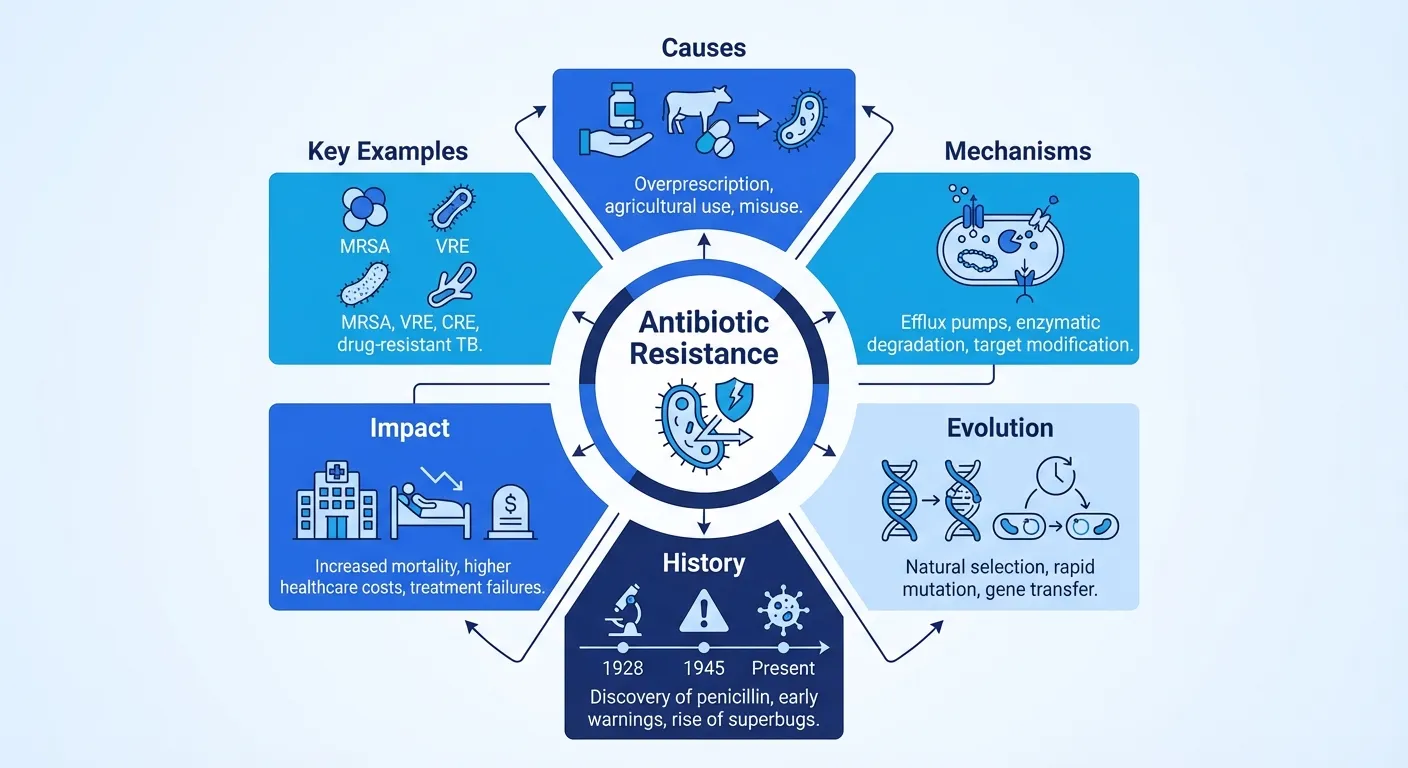
Causes driving the rise of resistance: overuse, misuse, and agriculture
Antibiotic resistance stems primarily from the ecological pressure exerted by the excessive and improper application of antimicrobial agents in human medicine and food production. This phenomenon is not new. On December 11, 1945, Alexander Fleming warned in his Nobel lecture that exposing microbes to penicillin concentrations too low to kill them could make them resistant, summarizing the misuse lesson as: “If you use penicillin, use enough.” Despite this early caution, modern healthcare systems still show inappropriate prescribing habits. Data from 2010–2011 indicate that clinicians in outpatient settings across the U.S. issued approximately 154 million prescriptions for these drugs each year. Alarmingly, 30%-about 47 million-of those prescriptions were unnecessary, primarily targeting respiratory conditions that do not respond to such treatments.
- Clinical Mismanagement: About 30% of antibiotics prescribed in U.S. acute care hospitals are unnecessary or suboptimal, including wrong drug selection, dosing, or treatment duration.
- Agricultural Prophylaxis: The use of growth promoters in livestock creates a reservoir for resistant pathogens that can jump to human populations.
- Regulatory Impact: After avoparcin was banned as a livestock growth promoter in Denmark and the EU, vancomycin-resistant Enterococcus faecium in Danish poultry flocks at slaughter fell from 82% in 1995 to 12% in 1998.
Efforts by the Food and Agriculture Organization of the United Nations (FAO), the World Organisation for Animal Health (WOAH), and the United Nations Environment Programme (UNEP) aim to mitigate these drivers. Beyond bacterial threats, the misuse of Artemisinin-based combination therapies (ACTs) has contributed to resistance in Plasmodium falciparum.
High-income vs. low- and middle-income countries: unequal burden
Disparities in healthcare infrastructure and drug access mean the AMR burden falls unevenly across the globe. While the threat is universal, low- and middle-income countries face the worst outcomes due to limited resources for infection control. Between 2000 and 2018, antibiotic consumption rates in low- and middle-income countries increased 76%, from 7.4 to 13.1 defined daily doses per 1,000 people per day. In contrast, rates in high-income countries remained stable during this period. This surge reflects expanding access but often lacks the diagnostic oversight common in wealthier nations.
The mortality statistics show a divide in outcomes. In 2019, the all-age death rate attributable to bacterial antimicrobial resistance was estimated at 27.3 deaths per 100,000 people in western sub-Saharan Africa. Australasia reported only 6.5 deaths per 100,000 people. The Lancet study further suggests that narrowing infection-prevention-and-control gaps between LMICs and high-income countries could avert 337,000 AMR-associated deaths. Addressing these inequities requires interventions in the most affected regions.
Global impact and current surveillance data
International surveillance of drug-resistant pathogens is central to modern public health, led by the World Health Organization (WHO). GLASS launched 22 October 2015. This collaborative system aggregates data to track resistance trends across different regions, standardizing antimicrobial resistance surveillance worldwide through the Global Antimicrobial Resistance and Use Surveillance System (GLASS).
| Surveillance Metric | Data Scope and Reach |
|---|---|
| Global Participation | Reports were submitted by 104 countries in 2023, with 110 countries participating between 2016 and 2023. |
| Case Volume | The system draws on more than 23 million bacteriologically confirmed cases of various infections. |
| Diagnostic Support | WHONET, available in 28 languages, supports surveillance in over 2,300 laboratories across more than 130 countries. |
| Analytical Depth | GLASS provides adjusted estimates for 93 infection type-pathogen-antibiotic combinations and tracks trends for 16 specific combinations. |
These surveillance tools track how resistance moves through populations.
GLASS 2022 data: E. coli, MRSA, and MDR-TB rates worldwide
Recent surveillance metrics for key pathogens show high resistance in both community and hospital settings. Data from 76 countries indicate that median resistance rates reached 42% for third-generation cephalosporin-resistant Escherichia coli. Furthermore, methicillin-resistant Staphylococcus aureus showed a median resistance rate of 35% in the same period. Global health depends on accurate tracking.
- One in 6 laboratory-confirmed bacterial infections causing common illnesses worldwide in 2023 were resistant to standard antibiotic treatments.
- More than 55% of Klebsiella pneumoniae globally were resistant to third-generation cephalosporins according to official manufacturer’s documentation and WHO reports.
- Resistance to third-generation cephalosporins in the WHO African Region exceeded 70% in recent analyses.
The scale of these resistance rates threatens effective infection management.
Impact on modern medicine: treatment failures and rising mortality
Human lives and global economic stability are at risk as antimicrobial resistance undermines standard medical interventions. In 2019, a comprehensive systematic analysis estimated that bacterial AMR was directly responsible for 1.27 million deaths. It was also associated with 4.95 million deaths that same year.
- If an infection is suspected:
- Administer standard first-line antibiotic therapy.
- If treatment failure occurs due to resistance:
- Escalate to second-line or “last-resort” drugs, increasing the risk of toxicity and cost.
- If last-resort drugs fail:
- The infection may become untreatable, leading to increased mortality.
Procedures once considered routine, such as caesarean sections or cancer chemotherapy, are now at risk due to the rise of untreatable infections. The financial burden is equally staggering. The World Bank estimates that AMR could result in US$1 trillion in additional healthcare costs by 2050. Annual GDP losses could reach between US$1 trillion and US$3.4 trillion by 2030. Protecting modern medicine requires immediate, coordinated action to address these escalating threats.
Slowing resistance: stewardship programs and evidence-based measures
Coordinated global initiatives now provide the framework necessary to mitigate the rising threat of drug-resistant pathogens through structured antimicrobial stewardship. The United Nations General Assembly High-Level Meeting on Antimicrobial Resistance, held in September 2016, served to solidify international political commitment toward these interventions. The Global Action Plan on Antimicrobial Resistance (GAP-AMR), adopted by WHO Member States in 2015, harmonizes cross-border responses. Success requires a One Health approach. This strategy integrates the management of human, animal, and environmental sectors to address the shared biological vulnerabilities that drive resistance.
- Mobilize political leadership through the Global Leaders Group on AMR and the Multi-Stakeholder Partnership Platform to ensure sustainable funding for national action plans.
- Support research and development through CARB-X, which launched in 2016 to invest up to US$450 million over five years to accelerate 20 new antibacterial products.
- Enhance public awareness during World AMR Awareness Week (WAAW) to promote responsible prescribing and patient adherence to treatment protocols.
How antibiotic stewardship programs reduce resistance in clinical settings?
Antimicrobial stewardship serves as the primary clinical strategy for preserving drug efficacy by ensuring the most appropriate therapy for every patient. The concept was formally introduced by John E. McGowan Jr. and Dale N. Gerding in 1996 to describe the systematic control of antibiotic use. By September 1997, professional guidelines established that these programs must optimize drug selection, dosing, and duration. These efforts are most effective when paired with rigorous infection control measures to prevent the transmission of resistant organisms within healthcare facilities.
- Clinicians should first verify the necessity of an antibiotic by reviewing diagnostic data and local susceptibility patterns before initiating therapy.
- Medical teams must then select the narrowest-spectrum agent possible and adjust the dosage based on the patient’s specific physiological needs.
Large-scale evidence confirms the clinical utility of these protocols. A 2017 Lancet Infectious Diseases meta-analysis demonstrated that antimicrobial stewardship programs reduced infections or colonization with multidrug-resistant Gram-negative bacteria by 51%. The same study reported a 48% decrease in extended-spectrum beta-lactamase-producing strains and a 37% reduction in methicillin-resistant Staphylococcus aureus. Furthermore, Clostridioides difficile infections dropped by 32% under these managed conditions.
Implementation at the national level shows similar success. The AHRQ Safety Program for Improving Antibiotic Use, involving 402 U.S. hospitals between late 2017 and late 2018, saw adherence to core stewardship components jump from 8% to 74%. Consequently, antibiotic use decreased from 900.7 to 870.4 days of therapy per 1,000 patient-days. This shift led to a 19.5% reduction in hospital-onset Clostridioides difficile events, illustrating the profound impact of evidence-based prescribing on patient safety.
Sources
- World Health Organization. Antimicrobial resistance health topic page.
https://www.who.int/health-topics/antimicrobial-resistance - fda.gov. U.
https://www.fda.gov/consumers/consumer-updates/know-when-and-how-use-antibiotics-and-when-skip-them - Abraham and Chain. An Enzyme from Bacteria able to Destroy Penicillin, Nature, 1940 (1940).
https://www.nature.com/articles/146837a0 - academic.oup.com. Gygli et al (1944).
https://academic.oup.com/femsre/article/41/3/354/3089982 - CDC. Kirkcaldy et al (1944).
https://stacks.cdc.gov/view/cdc/134172/cdc_134172_DS1.pdf - pmc.ncbi.nlm.nih.gov. Harkins et al (1960).
https://pmc.ncbi.nlm.nih.gov/articles/PMC5517843/ - CDC. National Antimicrobial Resistance Monitoring System: Enteric Bacteria 2004… (1986).
https://stacks.cdc.gov/view/cdc/24026/cdc_24026_DS1.pdf - CDC. MMWR, Staphylococcus aureus Resistant to Vancomycin, United States, 2002 (1996).
https://www.cdc.gov/mmwr/preview/mm5126a1.htm - EMA. Nelson et al.
https://pubmed.ncbi.nlm.nih.gov/20564518/ - nature.com. D’Costa et al (2011).
https://www.nature.com/articles/nature10388 - Davies and Davies. Origins and Evolution of Antibiotic Resistance, Microbiology and Molecular….
https://journals.asm.org/doi/10.1128/mmbr.00016-10 - Merck Manual Professional Edition. Overview of Beta-Lactams.
https://www.merckmanuals.com/professional/infectious-diseases/bacteria-and-antibacterial-medications/overview-of-beta-lactams - pmc.ncbi.nlm.nih.gov. Sivertsen et al.
https://pmc.ncbi.nlm.nih.gov/articles/PMC7020976/
F.A.Q
What is antibiotic resistance and why is it a problem?
Antibiotic resistance occurs when bacteria adapt to survive drugs meant to kill them. This makes infections harder to treat and increases the risk of complications or death.
How did antibiotic resistance first develop?
Bacteria began developing resistance soon after antibiotics were first introduced. With each new class of antibiotics, bacteria have evolved ways to survive.
What causes bacteria to become resistant to antibiotics?
Genetic changes in bacteria and the exchange of resistance genes drive resistance. Overuse or misuse of antibiotics in humans, animals, and the environment accelerates this process.
How is antibiotic resistance different from antimicrobial resistance (AMR)?
Antibiotic resistance refers to bacteria becoming resistant to antibiotics. AMR, or antimicrobial resistance, covers resistance in bacteria, viruses, fungi, and parasites to all types of antimicrobial drugs.
What are some examples of antibiotic-resistant infections?
Examples like carbapenem-resistant Enterobacteriaceae (CRE) and methicillin-resistant Staphylococcus aureus (MRSA) are tracked by health organizations because they pose serious public health risks.
What is being done to fight antibiotic resistance?
Global efforts focus on antimicrobial stewardship, careful prescribing, infection control, and new drug development to slow resistance.
How do stewardship programs help reduce antibiotic resistance in hospitals?
Stewardship programs ensure antibiotics are used only when necessary, with the correct drug, dose, and duration. This strategy has reduced resistant infections and improved patient safety.
