


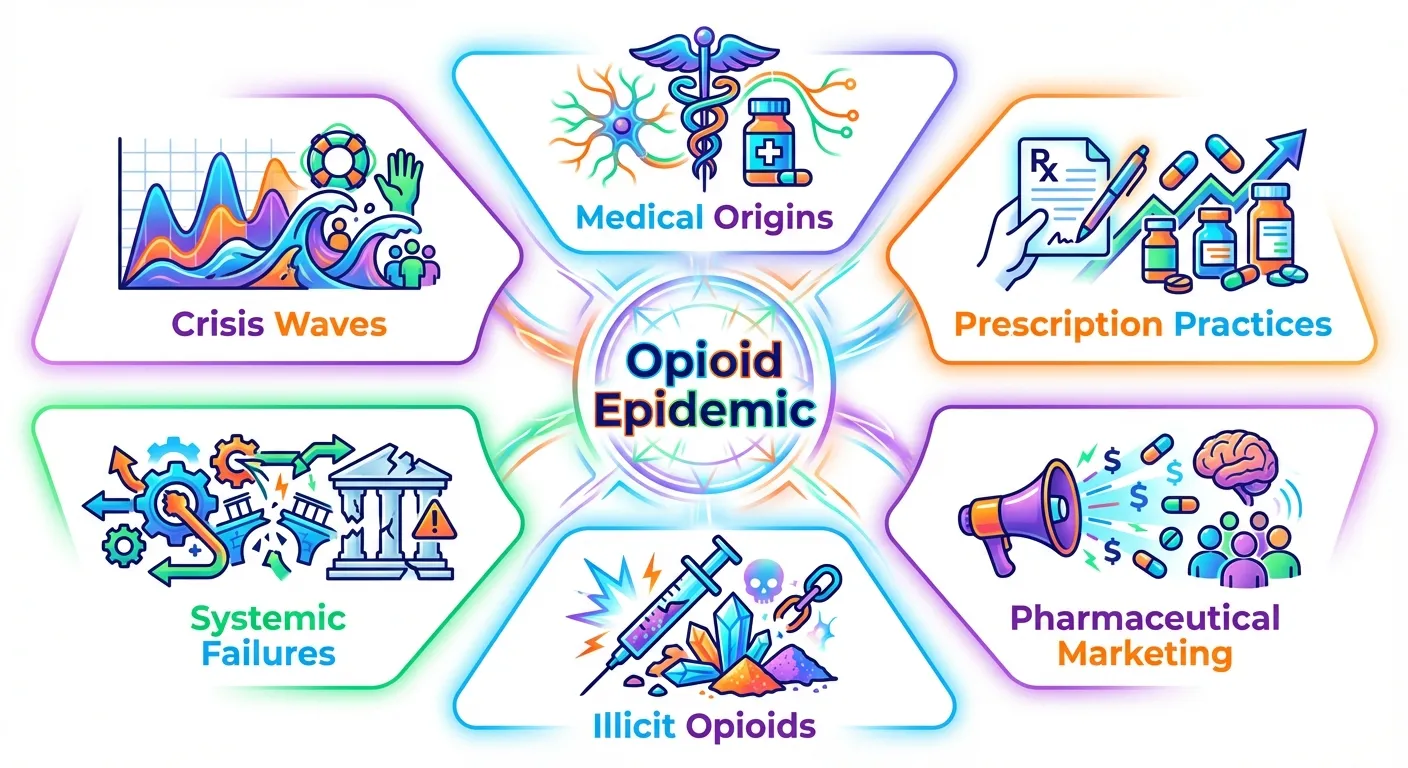
This public health crisis has reshaped the American landscape over the last quarter-century. Since the late 1990s, the Opioid Epidemic—defined as a massive surge in opioid misuse, addiction, and fatalities—has devastated communities across the United States. It remains a shifting challenge rooted in neurobiological mechanisms like mu-opioid receptor downregulation and social determinants such as rising unemployment rates in post-industrial counties. Given its immense scale, the crisis has touched virtually every community in the United States.
Opioid Use Disorder is a chronic medical condition characterized by neurochemical adaptations resulting from prolonged substance exposure, serving as a primary driver of the ongoing public health crisis. While the disorder represents the long-term physiological and behavioral aspect of addiction, an Opioid Overdose constitutes the acute, life-threatening manifestation of excessive opioid consumption. Analyzing how this situation escalated into a national emergency involves examining the clinical and systemic factors that shifted these substances from controlled medical applications to widespread societal health risks.
What is the opioid epidemic and why it qualifies as a public health crisis?
Over 105,000 lives were lost to drug overdoses in 2023 alone—a staggering figure that underscores the severity of the current national emergency (1). Opioids were involved in about 76% of these fatalities, which is why the situation is classified as a public health crisis with devastating societal consequences.
Federal response efforts depend on the specialized roles of several key organizations. The Centers for Disease Control and Prevention (CDC) leads by monitoring trends and issuing clinical guidelines to improve safety. Meanwhile, the Substance Abuse and Mental Health Services Administration (SAMHSA) provides the funding and coordination required for community-based treatment programs. Enforcement and tracking fall under the Drug Enforcement Administration, which utilizes systems like ARCOS to monitor controlled substance transactions from manufacture through commercial distribution to the point of sale.
NIH and CDC official positions on epidemic causes
Research from the National Institutes of Health and the Centers for Disease Control and Prevention points toward deep-seated systemic failures rather than isolated incidents. A 2019 review by experts from both agencies highlighted that insufficient training in pain management for clinicians created a dangerous environment (2). These institutional gaps precipitated a rapid rise in misuse across the country.
“Chronic pain affects about one in five U.S. adults, and the lack of safe, non-addictive pain treatments contributes significantly to the opioid crisis,” according to the NIH HEAL Initiative.
Transitioning from prescription use to illicit substances is a major driver of the ongoing emergency. Individuals who misuse prescription opioids are nearly 20 times more likely to initiate heroin use than those who do not (3). Within five years of initial misuse, between 4% and 6% make that transition (4). Among people currently using heroin, 80% report that their path began with the misuse of prescribed medications.
How prescription opioids and pharmaceutical marketing ignited the crisis?
Efforts to revolutionize pain management during the 1990s fundamentally altered the clinical landscape. Purdue Pharma saw OxyContin sales skyrocket from $48 million in 1996 to over $1 billion by the year 2000 (5). The Joint Commission introduced new standards in 2000 that required universal pain assessments, though the specific phrase was later removed from manuals by 2004 (6).
Government data reveal the staggering volume of medication that entered American communities at the peak of this era. According to DEA ARCOS records, approximately 76 billion oxycodone and hydrocodone pills were distributed across the United States between 2006 and 2012 (7). The following figure illustrates the correlation between distribution volume and the rise in reported misuse cases.
Pharmaceutical marketing’s role: evidence from NEJM and JAMA research
Medical literature and pharmaceutical marketing played a decisive role in convincing the healthcare community that certain narcotics carried minimal risk. Physicians were frequently told that long-term opioid therapy was a safe solution for chronic pain—a claim that overlooked the lack of long-term efficacy data for chronic non-cancer pain and the high probability of physical dependence developing within weeks of daily use.
- The NEJM letter influence: A five-sentence letter published in the New England Journal of Medicine in 1980 by Porter and Jick was frequently cited to prove addiction was rare. However, the data only described hospitalized patients rather than those on long-term outpatient therapy.
- Legal accountability for misbranding: In 2007, the Purdue Frederick Company pleaded guilty to felony misbranding of OxyContin with intent to defraud or mislead (8). The company paid $634.5 million in penalties following evidence of deceptive marketing practices.
- Aggressive marketing expansion: Between 1996 and 2000, the Purdue Pharma sales force grew from 318 to 671 representatives, utilizing a $200 million annual marketing budget and thousands of sponsored “Partners in Pain” seminars to influence physician prescribing habits.
FDA historical reviews and policy failures in opioid approval
Regulatory decisions made in the mid-1990s provided the legal framework for the widespread availability of long-acting narcotics. The Food and Drug Administration approved OxyContin in 1995 as the first 12-hour oxycodone formulation (U.S. Department of Justice / Purdue Frederick plea agreement, 2007), partly on the basis of prior experience with MS Contin—a controlled-release morphine product approved in 1987. Officials believed the extended-release mechanism would naturally deter misuse. It did not.
- The Food and Drug Administration underestimated the abuse potential of the new formulation, assuming it would be safer than immediate-release drugs.
- Experience with MS Contin suggested that controlled-release products did not generate significant abuse reports, leading to a false sense of security.
- Nonmedical use of OxyContin surged rapidly, rising from approximately 400,000 users in 1999 to 2.8 million by 2003, according to SAMHSA NSDUH data (9, 11).
The 2016 CDC prescribing guideline and its impact
Guidelines issued by federal health authorities marked a significant turning point in the effort to curb overprescribing. The CDC Guideline for Prescribing Opioids for Chronic Pain, United States, 2016 introduced 12 specific recommendations designed to prioritize non-opioid therapies and lower dosages (10). Its primary intent was to reduce the incidence of misuse and fatal overdose. The CDC Clinical Practice Guideline for Prescribing Opioids for Pain, United States, 2022 later updated these standards to include specific recommendations for acute and subacute pain management.
The four waves of the opioid epidemic: from painkillers to fentanyl analogs
Evolutionary shifts in the drug market define the four waves of this public health crisis—a transition from pharmaceutical products to highly potent illicit synthetics. Each period is categorized by the primary substance driving mortality. Currently, illicit fentanyl and various fentanyl analogs have saturated the illegal drug supply.
- First Wave
- Driven by the rise in prescription opioids starting in the late 1990s.
- Second Wave
- Characterized by a rapid increase in Heroin-involved deaths beginning in 2010.
- Third Wave
- Defined by the 2013 surge in synthetic opioids, particularly Fentanyl.
- Fourth Wave
- Marked by the co-involvement of stimulants like cocaine and methamphetamine with opioids.
Transition from prescription opioids to heroin and illicit fentanyl
Comparing the trajectories of different substances reveals a volatile shift in the American drug landscape over the last two decades. Prescription opioid-involved overdose deaths rose significantly during the late 1990s and early 2000s, then declined in recent years as regulations tightened. Heroin-involved deaths increased sharply from 2010, though those numbers have also trended downward more recently.
Despite these declines, the historical impact remains staggering. In 2016, over 11 million Americans misused prescription opioids and nearly 1 million used heroin. That same year, approximately 2.1 million individuals met the criteria for a substance use disorder involving either prescription opioids or heroin.
The fourth wave: polysubstance deaths involving stimulants
Rising rates of polysubstance overdose represent the latest and most lethal development in the national drug crisis.
- Methamphetamine: Frequently found in combination with synthetic opioids in the western United States.
- Cocaine: A major contributor to polysubstance deaths, particularly in urban centers.
- Fentanyl Analogs: Often mixed into the stimulant supply without the user’s knowledge.
Data from several jurisdictions indicates that nearly half of opioid overdose deaths now also involve psychostimulant drugs. The following section provides a detailed breakdown of overdose death statistics recorded from 1999 through 2023.
Opioid overdose death statistics: 1999 to 2023
Fatalities linked to opioid use have surged dramatically over the last quarter-century, reaching a scale that has fundamentally altered American mortality data. According to the National Center for Health Statistics, the rate of opioid overdose deaths in 2023 was nearly 10 times higher than the rate recorded in 1999—a trajectory that claimed approximately 806,000 lives during that 24-year window. Despite this long-term rise, 2023 marked a significant statistical shift: the first year to see an annual decline, with deaths dropping by 4% compared to 2022.
Detailed records from the CDC WONDER database reveal that the burden of this crisis falls disproportionately on specific populations, with American Indian and Alaska Native individuals experiencing the highest overdose death rates of any racial or ethnic group. Furthermore, men aged 35 to 44 currently represent the demographic with the greatest number of fatalities, while geographic data indicates that the Appalachian and New England regions continue to report the highest concentrations of synthetic opioid-related mortality.
Prescription opioids vs. heroin vs. synthetic opioids as overdose drivers
Shifting patterns in substance availability have fundamentally altered the landscape of the overdose crisis. Early waves were defined by different substances, but synthetic opioids—primarily illicit fentanyl and its analogs—have driven the most recent and most lethal surge of deaths.
- Synthetic opioids: These potent substances saw a slight 2% decrease in death rates during 2023.
- Heroin: Fatalities involving this drug plummeted by 33% in 2023, continuing a sharp downward trend.
- Prescription opioids: Deaths in this category declined by nearly 12% as monitoring and prescribing habits changed.
Synthetic opioids, primarily illicitly manufactured fentanyl, continue to drive the mortality rate, accounting for approximately 70% of all overdose deaths in 2023 according to provisional CDC data.
2022-2023 decline: a turning point or a temporary dip?
Whether the recent downturn represents a permanent shift in the trajectory of the crisis remains a subject of intense debate. In 2023, approximately 81,000 opioid-involved deaths occurred—accounting for 75% of all drug overdose deaths that year.
Regional data reveals a complex and uneven picture. From 2022 to 2023, the age-adjusted overdose-death rate involving any opioid decreased significantly in 20 states. However, nine states saw significant increases, including California, Oregon, and Washington. Preliminary figures for 2024 from the National Center for Health Statistics suggest the decline may be accelerating.
Secondary health consequences: NAS, hepatitis C, opioid use disorder, and beyond
Fatalities represent only the most visible layer of a crisis that leaves millions of survivors grappling with chronic physiological damage and systemic infections. Between 2010 and 2017, the United States witnessed an 82% rise in the rate of Neonatal Abstinence Syndrome (NAS), climbing from 4.0 to 7.3 cases per 1,000 birth hospitalizations. Beyond the nursery, acute Hepatitis C infections surged more than fivefold from 2010 to 2020, primarily driven by increased opioid injection—with an estimated 66,700 new infections in 2020 alone, placing immense strain on public health infrastructure.
Healthcare facilities face an unprecedented volume of opioid-related hospitalizations that extend far beyond overdose stabilization. From 2005 to 2014, the national rate of opioid-related inpatient stays grew by 64.1%, while emergency department visits for similar causes nearly doubled with a 99.4% increase. These visits often involve severe bacterial infections like Endocarditis, which targets the heart valves. North Carolina data illustrates this trend clearly: hospital discharge diagnoses combining drug dependence and Endocarditis rose from 0.2 to 2.7 per 100,000 persons annually between 2010 and 2015.
- Infectious and Cardiac Risks: Increased transmission of HIV through shared equipment, along with elevated risks of cardiac arrest and heart failure.
- Gastrointestinal and Neurological Effects: Chronic constipation, persistent nausea, vomiting, and frequent dizziness.
- Systemic Dysfunctions: Sleep problems, low blood pressure, slower heart rate, sexual dysfunction, and clinical depression.
Emerging threats: xylazine, fentanyl analogs, and the evolving crisis
Recent shifts in the illicit drug market have introduced a dangerous new phase characterized by the rapid diversification of synthetic additives, most notably xylazine. According to DEA laboratory data, the prevalence of xylazine in fentanyl seizures increased by 193% in the South and 112% in the West between 2020 and 2021, signaling a systemic change in supply composition. Unlike heroin, which relies on agricultural cycles and favorable weather, these synthetic compounds are manufactured in laboratory settings throughout the year.
- Xylazine and Fentanyl Analogs are substances that pose significant risks.
- A non-opioid veterinary tranquilizer, xylazine is now frequently mixed with illicit fentanyl and various fentanyl analogs to prolong the sedative effects. Because it is not an opioid, standard overdose reversal agents like naloxone do not work on its sedative properties, significantly complicating emergency response efforts.
- Heroin Substitution
- The phenomenon of heroin substitution accelerated as prescription opioids became prohibitively expensive and difficult to acquire. Research indicates that 94% of individuals in addiction treatment chose heroin specifically because prescription alternatives were no longer accessible.
- Abuse-Deterrent Reformulations
- The 2010 redesign of OxyContin to prevent crushing or dissolving had the unintended consequence of pushing users toward more lethal alternatives, as many switched to heroin and illicit fentanyl. Data shows that every 1-percentage-point drop in OxyContin misuse following this change was linked to 3.1 additional heroin deaths per 100,000 people.
- Counterfeit Pills
- Illicit fentanyl is increasingly pressed into counterfeit pills designed to mimic the appearance of legitimate benzodiazepines or prescription stimulants.
Sources
- CDC. /NCHS Data Brief No (2023).
https://www.cdc.gov/nchs/products/databriefs/db522.htm - pmc.ncbi.nlm.nih.gov. Compton, Jones, and Baldwin, Epidemiology of the U (2019).
https://pmc.ncbi.nlm.nih.gov/articles/PMC6984757/ - samhsa.gov. SAMHSA CBHSQ Data Review, Associations of Nonmedical Pain Reliever Use and….
https://www.samhsa.gov/data/sites/default/files/DR006/DR006/nonmedical-pain-reliever-use-2013.htm - National Academies of Sciences. Engineering, and Medicine, Medications for Opioid Use Disorder Save Lives.
https://www.nationalacademies.org/read/25310/chapter/3 - Van Zee. The Promotion and Marketing of OxyContin: Commercial Triumph, Public Health… (1996).
https://pmc.ncbi.nlm.nih.gov/articles/PMC2622774/ - asam.org. Baker, History of The Joint Commission’s Pain Standards: Lessons for Today’s… (2000).
https://www.asam.org/docs/default-source/education-docs/rethinking-jcaho-pain-standards-jama-2-23-17.pdf?sfvrsn=6b0640c2_2 - DEA. The Washington Post analysis of DEA ARCOS data released in federal opioid… (2006).
https://www.washingtonpost.com/investigations/76-billion-opioid-pills-newly-released-federal-data-unmasks-the-epidemic/2019/07/16/5f29fd62-a73e-11e9-86dd-d7f0e60391e9_story.html - EPA (2007).
https://media.defense.gov/2007/May/10/2001711223/-1/-1/1/purdue_frederick_1.pdf - FDA. Timeline of Selected FDA Activities and Significant Events Addressing… (1995).
https://www.fda.gov/drugs/food-and-drug-administration-overdose-prevention-framework/timeline-selected-fda-activities-and-significant-events-addressing-substance-use-and-overdose - CDC. MMWR, CDC Guideline for Prescribing Opioids for Chronic Pain, United… (2016).
https://www.cdc.gov/mmwr/volumes/65/rr/rr6501e1.htm
F.A.Q
What caused the opioid epidemic in the United States?
The opioid epidemic accelerated because doctors overprescribed painkillers, drug companies promoted their products aggressively, and clinicians lacked sufficient training in pain management.
How did prescription opioids lead to widespread addiction?
Many people became addicted after being prescribed opioids for pain. Misuse of prescription opioids greatly increased the likelihood of later using heroin or illicit fentanyl.
Why is the opioid epidemic considered a public health crisis?
Hundreds of thousands of deaths and major strain on healthcare systems have resulted from the epidemic. Nearly every U.S. community has been affected, with opioids involved in about 76% of overdose deaths.
What role did pharmaceutical companies play in the opioid crisis?
Pharmaceutical companies promoted opioids as safe and downplayed the risk of addiction, fueling a surge in prescriptions and widespread misuse.
How has the opioid epidemic changed over time?
The crisis has shifted from prescription painkillers to heroin and synthetic opioids such as fentanyl. New threats like xylazine have made emergency responses even more difficult.
What are the health risks associated with opioid misuse?
Opioid misuse can cause overdose, infections like HIV, heart infections, stomach problems, and neurological issues including depression and sleep disturbances.
How did changes in opioid formulations affect the epidemic?
Abuse-deterrent versions of drugs like OxyContin made prescription opioids harder to misuse. However, many users turned to heroin or illicit fentanyl, which pushed overdose deaths even higher.
