
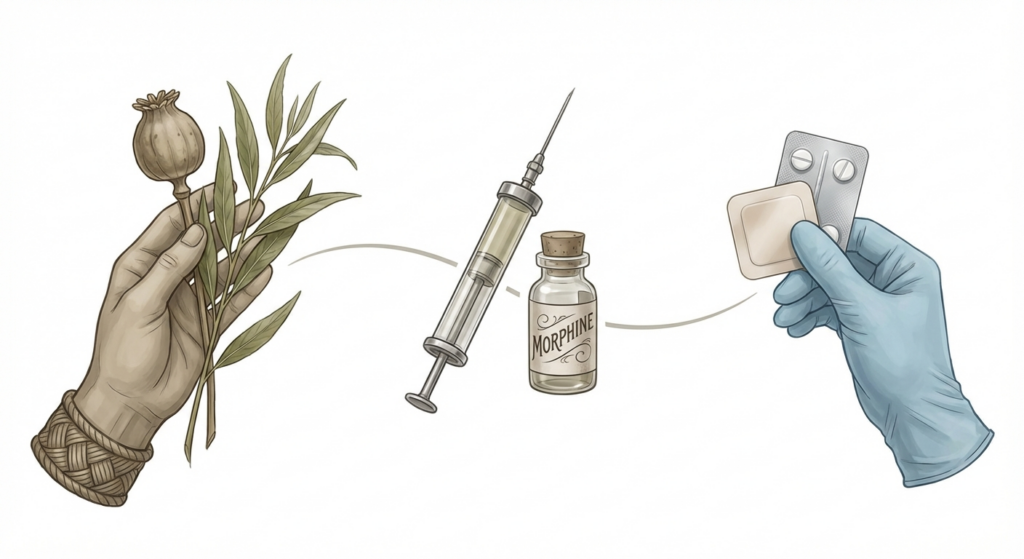
It was Friedrich Sertürner who pulled morphine from opium in 1804, turning a crude plant exudate into a measurable alkaloid that physicians could dose with precision rather than guesswork. (Source: Britannica (Morphine) 2026 – britannica.com/science/morphine)
Relief from pain advanced because chemistry concentrated efficacy, medicine paid for that advance because the same concentration narrowed the distance between sedation and respiratory collapse.
The central paradox appeared early: the poppy gave physicians a tool that could crush agony with unmatched force, and the same chemistry derived from the poppy built dependence, overdose, and institutional blindness into routine practice.
Rarely has one drug lineage fused benefit and liability so tightly. The receptor pathway that blunts relief from pain also depresses breathing and rewards repeated use.
Carved out of that molecular overlap came every later dispute over painkillers – from surgical analgesia to modern prescribing controls.
Opium predates laboratories by millennia, and physicians in Mesopotamia, Egypt, Greece, India, and later Islamic medicine treated pain with poppy preparations long before anyone could name an alkaloid or quantify a receptor response. (Source: Britannica (Opium) 2026 – britannica.com/science/opium)
Ancient healers did not inherit a harmless botanical; they inherited a variable narcotic whose potency shifted with harvest conditions, preparation methods, dilution, and trade adulteration.
Short records. Long consequences. Galen praised opium, yet Galen also warned that the drug could kill when dose exceeded tolerance, a contradiction that later pharmacology dressed in cleaner language without removing the hazard.
Pressed by surgery, war injuries, renal colic, tooth extraction, and relief from pain after surgery in every premodern form, physicians kept returning to the same substance because nothing else matched its force.
Aspirin hadn’t arrived, ether hadn’t arrived, reliable anesthetic systems hadn’t arrived. Opium endured as an entrenched protocol because severe pain cornered practitioners into choosing relief despite volatility, and that bargain hasn’t changed.
Origins of pain relief in ancient civilizations
Entangled with ritual, trade, and crude pharmacology, ancient pain relief began as plant handling rather than medical theory. (Source: PBS FRONTLINE / NLM 2026 – pbs.org/wgbh/frontline/wgbh/pages/frontline/shows/heroin/etc/history.html) Sumerian handlers used opium from the poppy plant by about 3400 BCE, and Egyptian scribes fixed willow bark into writing around 1550 BCE in the Ebers Papyrus.
Greek physicians later converted those inherited substances into named prescriptions when Hippocrates, active around 460 – 370 BCE, used willow bark extract to reduce pain and fever.
Ancient doctors lacked chemical isolation. Ancient doctors still treated pain.
That contradiction matters because early medicine discovered the same bargain later laboratories would rediscover: the substances that most effectively muted suffering also carried unstable potency, sedation, and dependence in the same material source.
Dragged by wounded bodies, childbirth, dental extraction, bone setting, and primitive surgery, physicians chose agents that worked before they understood why they worked.
The Ebers Papyrus recorded willow bark for general aches, yet Egyptian practice also used opium-containing preparations for children and other patients, binding soothing effect to narcotic risk from the start. Hippocrates did not prescribe opium as his central analgesic line – he went with willow bark extract instead, which undercuts the common assumption that relief from ancient pain depended chiefly on the poppy.
Dioscorides later described opium medicinally in the classical world. That textual continuity hardened relief from pain from plants into an entrenched protocol across centuries.
Nobody separated safety from efficacy. Nobody could. Ancient civilizations found relief from pain first and dosing that was standardized later, and the split never closed.
Hippocrates prescribed willow bark, not opium, defying the myth that ancient relief from pain relied on the poppy.
Where did painkillers originate?
It was the opium poppy, Papaver somniferum, that gave painkillers their earliest documented origin in ancient Sumer.
Sumerian cultivators handled the plant for its narcotic latex long before pharmacists could isolate a single active compound, and later Mediterranean physicians inherited that practical knowledge as a commodity for medicine rather than as a biochemical concept.
Greek and Roman writers didn’t invent analgesia – they codified older plant use into medical texts, dose habits, and trade routes. The line that leads to morphine begins there. No clean origin exists.
Forced by materia medica rather than laboratory science, Pedanius Dioscorides described opium as a medicinal substance in the classical Mediterranean world, preserving a pharmacologic lineage that survived because physicians kept observing suppression of severe pain despite inconsistent preparations and obvious intoxication.
Another lineage began elsewhere in the same ancient archive: willow bark supplied salicin, and later chemists converted salicin into salicylic acid, the precursor route that eventually produced modern non-opioid relief from pain.
Friedrich Sertürner altered the entire field in 1804 when he isolated morphine from opium (working alone in his pharmacy in Paderborn), proving that a plant long treated as a mixed narcotic resin contained a discrete alkaloid with far greater concentration and predictable effect than raw preparations.
One plant fed empire. One molecule changed dosing.
Anchored to those dual origins, later medicine for relief from pain inherited two incompatible demands from the same historical root: physicians wanted maximal relief, and patients required protection from the very compounds that delivered it.
Opium generated the line of strong-analgesic by concentration and receptor potency. Willow generated the anti-inflammatory line by derivation and modification of the chemistry. Neither line escaped cost.
Morphine sharpened efficacy and sharpened overdose risk with it, while salicylic derivatives reduced some narcotic hazards but introduced injury to the stomach and bleeding. Ancient origin stories read like pharmacognosy. They operate like warnings.
How people managed pain before painkillers existed
Spilled into surgery, childbirth, and trauma care, premodern pain management relied on endurance, restraint, alcohol, and crude narcotics more than on any true abolition of pain. (Source: U.S. National Library of Medicine 2026 – nlm.nih.gov/exhibition/the-story-of-aspirin/digitalgallery-nojs-detail01.html)
Egyptian scribes around 1500 BCE recorded willow bark for aches and pains, yet most invasive procedures still proceeded with partial dulling rather than complete insensibility.
Greek and Roman physicians used willow bark, mandrake, and opium-bearing mixtures because patients demanded some relief from pain even when full analgesia remained unattainable. Bodies stayed awake. Knives didn’t wait.
Rarely has anesthesia looked less like control than in the centuries before ether and chloroform entered operating rooms. Historical operators used alcohol and opium to blunt surgical pain, but those agents frequently sedated patients without immobilizing them or suppressing agony during the procedure. The combination was unpredictable at best.
Trepanation demonstrates the point with brutal clarity: many patients underwent skull drilling in eras when no inhalational anesthetic existed, and survival depended as much on speed, restraint, and luck as on any pharmacologic aid.
Ether and chloroform belong to a later threshold. Earlier operators didn’t have either. Patients remembered.
Before the discovery of ether and chloroform, most surgical procedures relied on crude narcotics, alcohol, and physical restraint rather than true anesthesia.
Coerced into treatment by obstructed labor, fractures, abscesses, bladder stones, and battlefield injury, patients accepted pain because refusing intervention often meant death, deformity, or septic decline.
That clinical coercion exposed the old paradox in its bare form: relief from pain remained inadequate until stronger agents appeared, yet every step toward stronger agents tightened the link between mercy and hazard.
Ether and chloroform eventually reduced operative torment (first used successfully at Massachusetts General Hospital in 1846), but they also transferred danger into dosage, airway failure, and anesthetic miscalculation. Premodern medicine didn’t solve pain. It redistributed suffering.
How painkillers evolved from natural remedies to modern pharmaceuticals
Chemistry forced nineteenth-century medicine to convert plants into named molecules. Folk remedies became industrial pharmacology. (Source: Britannica (Morphine) 2026; Bayer 2025 – britannica.com/science/morphine)
Friedrich Sertürner pulled morphine out of opium in 1804, Felix Hoffmann synthesized acetylsalicylic acid at Bayer on August 10, 1897, and Bayer sold Aspirin under that trade name beginning in 1899.
Laboratories didn’t replace old remedies with safer ones. They concentrated old remedies into stronger forms, shipped them to wider markets.
Heroin proved that point with clinical brutality: chemists synthesized it from morphine in 1894, and Bayer introduced it in 1898 as a refined product – supposedly better than the older narcotic it came from.
Refinement has rarely produced so much confusion about safety. Bayer marketed heroin as a non-addictive substitute for morphine, which means one of the earliest flagship pharmaceutical “improvements” made worse the exact dependence problem it claimed to solve.
Aspirin followed a different route from willow through salicylate chemistry, but that route showed the same structural exchange – purification and dosing that was standardized improved how predictable the doses were without getting rid of harm.
Pharmacies gained labels, patents, and dosing that was standardized. Patients gained access. Doctors gained potency.
But drugmakers also scaled risk, because every successful lineage of analgesics carried forward the old bond between relief from pain and injury in a more concentrated, more marketable form. The contradiction held.
Bayer sold heroin as a non-addictive morphine, worsening the very dependence it promised to fix.
What painkillers were used in the 1800s?
Morphine, codeine, opium preparations, and late-century salicylates dominated nineteenth-century treatment of pain.
Physicians inherited raw opium from earlier centuries, then shifted toward purified alkaloids once chemistry allowed separation of active agents from plant mass. Codeine was isolated from opium in 1832 – giving doctors another opioid with less analgesic strength than morphine but continuing the same poppy-derived lineage.
Chemistry based on salicylates entered later. It widened the field beyond narcotics. The century mixed plant residue with isolated compounds.
- Morphine isolation (1804) – converted variable poppy extract into a dosable alkaloid, enabling precise surgical and battlefield pain control
- Codeine isolation (1832) – provided a milder opioid option for cough and moderate pain, expanding the clinical menu beyond morphine
- Salicylate chemistry – allowed for the development of non-opioid painkillers, decreasing reliance on narcotics for everyday pain
- Hypodermic syringe adoption – enabled direct injection of morphine and other drugs, increasing both efficacy and risk of dependence
Surgeons grabbed at these drugs when confronting postoperative pain, neuralgia, trauma, and cancer – the hypodermic method altered painkiller use as much as any new molecule did. (Source: Smithsonian / JAMA / historical sources 2026 – americanhistory.si.edu/collections/object/nmah_730862)
Francis Rynd introduced the hollow needle, Charles-Gabriel Pravaz developed the piston syringe, and Alexander Wood used the hypodermic syringe to administer morphine, allowing physicians to deliver fast, concentrated doses directly beneath the skin.
Charles Frédéric Gerhardt had already described acetylsalicylic acid in 1853 – decades before Bayer commercialized aspirin – which means the famous aspirin launch did not begin with Bayer’s invention of the compound.
Methods mattered. Branding followed.
Nineteenth-century treatment for pain looked modern in packaging long before it became modern in controlling risk, fractured into oral tinctures, injected opioids, cough mixtures, powders, and proprietary tablets.
Stronger delivery increased how fast the therapy worked, yet the same syringe that improved relief from pain also amplified overdose potential and habitual use by removing delay, taste, and much of the patient’s capacity to self-limit intake.
Physicians gained control over episodes of relief from pain. But patients inherited a tighter pharmacologic tether to dependence and suppression of the respiratory system. The century expanded options, it didn’t loosen the trap.
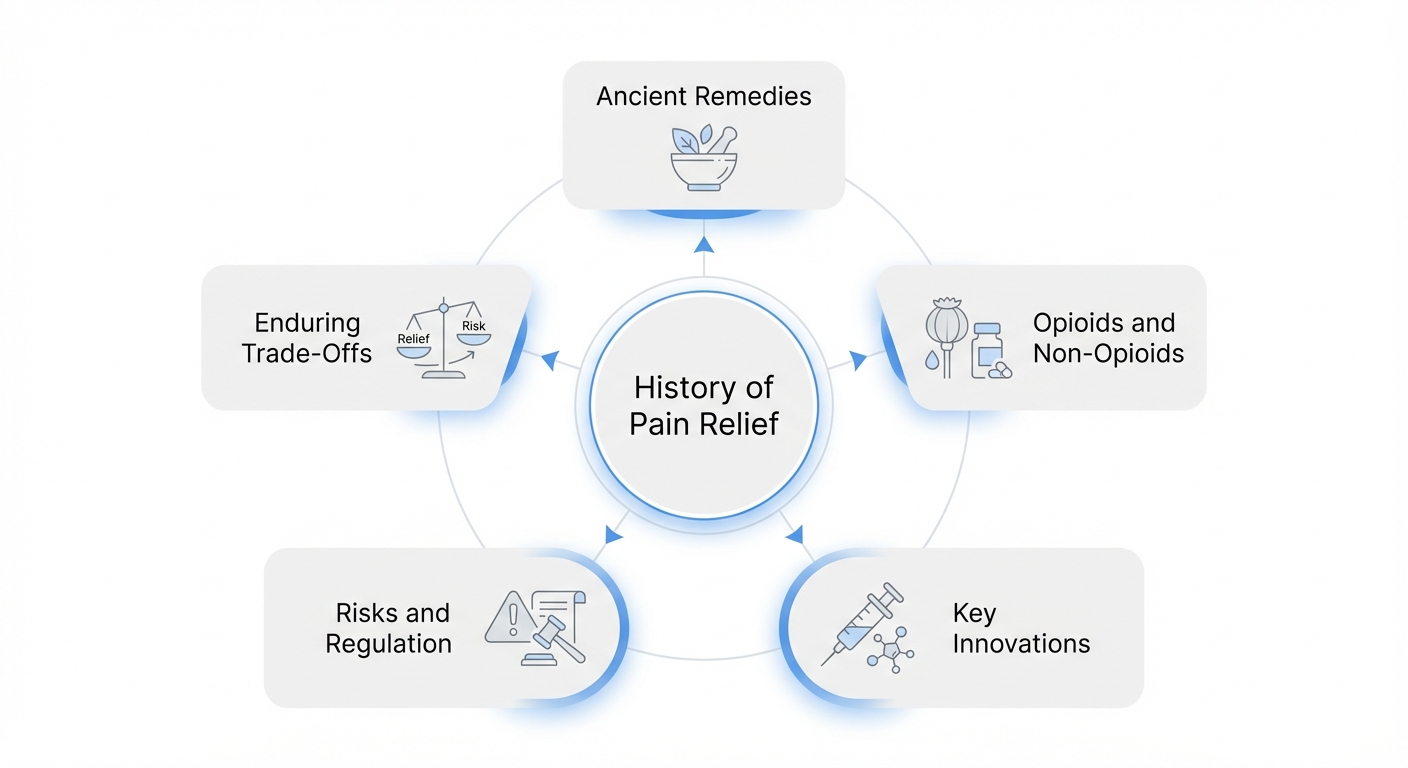
Key milestones in painkiller development
Carved out of pharmacology, surgery, and pain theory, the major milestones in pain relief did not arrive as a smooth ascent but as a sequence of partial corrections to older failures. (Source: JAMA Neurology 2026 – jamanetwork.com/journals/jamaneurology/fullarticle/590424)
John J. Bonica published the first edition of The Management of Pain in 1953 and gave doctors a systematic clinical framework for pain that medicine had long treated as a symptom to mute rather than a field to study.
Stewart Adams and John Nicholson discovered ibuprofen in 1961 at Boots in Nottingham, UK, and their work widened the non-opioid route by targeting inflammation with a drug intended to be safer than aspirin for many users.
Ronald Melzack and Patrick Wall then published the gate control theory of pain in 1965, shifting pain from a simple signal model toward a modulated nervous-system process. Science changed the map. Patients still hurt.
- Morphine isolation (1804) – enabled precise dosing and set the standard for opioid analgesia
- Aspirin synthesis (1897 – 1899) – introduced the first widely available non-opioid analgesic, reducing reliance on narcotics for common pain
- Heroin synthesis and marketing (1894 – 1898) – created a new, potent opioid that was initially misrepresented as safer than morphine
- Ibuprofen discovery (1961) – provided a safer alternative to aspirin for many patients with inflammatory pain
- Gate control theory (1965) – reframed pain as a complex, modulated phenomenon, influencing research and treatment approaches
It was acetaminophen that exposed the lag between synthesis and use with unusual clarity. Chemists made paracetamol in 1878, yet drugmakers did not market it for pain relief until the mid-twentieth century – one of the world’s most common painkillers sat outside routine pain practice for decades after its creation.
Bonica’s text, ibuprofen’s discovery, and gate control theory didn’t solve the old contradiction; they redistributed it across cleaner prescribing, wider categories, and better mechanistic language.
Doctors gained more options for relief from pain without escaping trade-offs in liver injury, gastrointestinal bleeding, renal stress, sedation, misuse, and under-treatment. Medicine for relief from pain matured institutionally. The bargain remained.
Acetaminophen was synthesized in 1878 but waited decades before becoming a routine painkiller.
What was the first painkiller in history?
It was opium that served as the first well-documented painkiller in recorded history. The dried latex of Papaver somniferum entered medicine long before chemists could pull out alkaloids, and ancient healers treated it as a direct suppressor of severe suffering rather than as a theoretical drug class.
A Sumerian clay tablet dated to about 2100 BC stands among the oldest recorded medicine lists and ties the poppy to medicinal use at the documentary level, not merely by archaeological inference. The record is old. The drug is older.
Pressed by war wounds, childbirth trauma, fractures, tooth extraction, and abdominal agony, Babylonian, Assyrian, Greek, and Roman practitioners kept opium in circulation because competing agents couldn’t match its brute force against pain.
Encyclopaedia Britannica places opium use for pain at least as far back as Babylonian civilization, and ancient Assyrian herb lists also referred to both the poppy and its use in medicine.
Greek and Roman physicians later treated opium as a powerful pain reliever in practice that was written and medical, which indicates continuity across cultures rather than isolated experimentation. Before synthetic analgesics appeared in the nineteenth century, opium remained the principal strong painkiller for centuries. That endurance was no accident.
Opium stands as the oldest well-documented painkiller, with continuous use from ancient Sumer through the classical world and into modern times.
Dragged by necessity into every era of severe pain, opium established the governing contradiction for the whole analgesic archive: the oldest effective painkiller already fused rescue with damage in a single substance.
Later chemistry improved purity, labeling, distribution, and route of administration, yet those improvements didn’t repeal the old linkage between relief from pain and respiratory danger, tolerance, and dependence.
Morphine merely concentrated what opium had long contained. Modern opioid policy still argues with a Sumerian inheritance. The molecule lineage never left.
The oldest known pain medications
Rarely has a medical hierarchy remained so stable for so long: opium stands as the oldest well-documented pain medication.
Ancient texts place it in Babylonian civilization, and later Greek and Roman practice preserved its place as a potent analgesic after empires, languages, and doctrines for therapy changed around it.
Opium didn’t survive because physicians lacked imagination. Opium survived because it worked where weaker herbs failed. That clinical fact governed centuries.
- Opium – the dried latex of the poppy, used in Mesopotamia, Egypt, Greece, and Rome for severe pain
- Willow bark – source of salicin, used in ancient Egypt and Greece for fever and mild pain
- Mandrake – used in classical and medieval medicine for its sedative and pain-relieving effects
- Alcohol-based preparations – employed across ancient and medieval cultures for dulling pain, especially in surgery
Embedded in classical and Near Eastern medicine, opium occupied a status that later historians sometimes misread as primitive improvisation, though the documentary record shows repeated deliberate use for pain control.
Encyclopaedia Britannica states that opium served for centuries as the principal strong relief from pain, and the U.S. DEA Museum records that Greek and Roman physicians knew it as a powerful agent for relief from pain.
Morphine – pulled out by Friedrich W.A. Sertürner around 1804 – arrived far later than the poppy itself and therefore belongs to the modernization of an ancient drug rather than to the origin of analgesia. The plant came first. The alkaloid came later.
Forced into continuity by severe human pain, the oldest medications revealed a structural limit that later pharmaceuticals never escaped: every step toward greater potency or greater purity preserved the old debt from use for therapy.
A physician could change the preparation from poppy latex to morphine ampoule, yet the physician couldn’t separate relief from suppression of respiration or from the risk that repeated exposure would recruit dependence.
Ancient medications for relief from pain look crude beside modern tablets, but the clinical exchange they imposed remains recognizably current. The packaging changed.
What was the original painkiller?
It was opium that functioned as the original strong painkiller, not aspirin and not any later branded tablet.
Ancient physicians used poppy latex centuries before Bayer named Aspirin, and those early users reached for opium because no later public-relations narrative can erase its primacy in severe relief from pain. Aspirin belongs to a different lineage, one rooted in salicylates and later chemistry on a factory scale rather than in the first documented suppression of major pain. Branding came much later. History didn’t.
- Opium – established as the principal strong painkiller from ancient Sumer through the classical era
- Aspirin – derived from willow bark and synthesized as acetylsalicylic acid in the late 19th century, providing a non-narcotic alternative
- Morphine – isolated in 1804, representing the first pure alkaloid opioid and setting the stage for modern pain pharmacology
- Heroin – synthesized from morphine in 1894, initially marketed as a safe alternative but quickly recognized as highly addictive
Fractured into patent claims and credit disputes, the aspirin story shows how industrial medicine often rearranged ownership more aggressively than origin.
Bayer’s naming formula for aspirin drew from “a” for acetyl and “spir” from Spiraea – the meadowsweet association tied to salicylate history – then the company fixed the product into commercial identity through trademark and market penetration.
Arthur Eichengrün later disputed Felix Hoffmann’s sole credit and claimed he had planned or directed aspirin’s development, while Heinrich Dreser held institutional authority over pharmacologic evaluation inside Bayer. Names shifted. The chemical line remained salicylate-derived rather than original in the deep historical sense.
Coerced into choosing between immediate relief and later harm, doctors repeatedly favored the agent that controlled relief from pain fastest, whether that agent came from a field, a bench chemist, or a factory trademark.
Opium occupied the original position because it answered urgent suffering with unusual force; aspirin later widened access to non-opioid relief but didn’t erase the older narcotic inheritance or the costs attached to every effective analgesic line. The dispute over inventors matters for patents and prestige. The patient still confronts the same bargain: relief arrives attached to risk. Unchanged.
Major categories of painkillers developed throughout history
Tangled up with chemistry and clinical need, painkillers broke into major categories by source, mechanism, and intended use – not through any clean historical succession.
Opioids formed the oldest major class, starting with medical opium in ancient Mesopotamia and later stretching to morphine, heroin, meperidine, and fentanyl.
Salicylates and later NSAIDs formed another line after salicin was pulled from willow bark in 1828 and acetylsalicylic acid entered pharmaceutical use at the end of the nineteenth century.
Local anesthetics became a distinct category in the late nineteenth century after cocaine isolation created drugs that blocked pain transmission regionally rather than suppressing the whole brain.
Acetaminophen entered as a separate non-opioid class after synthesis in 1878 and broader analgesic use in the twentieth century. Categories multiplied, risk didn’t too.
- Natural opioids – derived from opium poppy, including morphine and codeine, used for severe and acute pain
- Non-opioid analgesics (NSAIDs) – including aspirin, ibuprofen, and naproxen, targeting inflammation and mild-to-moderate pain
- Acetaminophen – synthesized in 1878, widely used for pain and fever with a distinct risk profile (hepatotoxicity)
- Local anesthetics – such as cocaine and lidocaine, enabling regional pain blockade for surgery and dental procedures
- Synthetic opioids – laboratory-designed drugs like meperidine, methadone, and fentanyl, increasing both potency and overdose risk
It was local anesthetics, not opioids, that often gave physicians the most targeted pain control for procedures – a fact that cuts against the common assumption that stronger relief from pain always required stronger systemic narcotics.
Each category solved a different problem in the clinic. Opioids treated severe systemic pain, NSAIDs reduced pain from inflammation, acetaminophen lowered pain and fever without major anti-inflammatory action, and local anesthetics blocked peripheral nerve conduction in a defined area.
Synthetic opioids then scrambled classification by keeping action at the opioid receptor while abandoning direct plant origin; meperidine and fentanyl came from laboratory design, not poppy harvest.
Physicians gained a larger menu, yet every shelf preserved the old exchange between relief from pain and hazard in a new form, whether the hazard was respiratory depression, gastrointestinal bleeding, hepatotoxicity, arrhythmia, or misuse. No class stayed innocent.
Local anesthetics, not opioids, often gave the most targeted control of pain for procedures.
<
How government regulation of painkillers has changed over time
Clutched by tax law before it was governed by modern pharmacovigilance, painkiller regulation began as control of trade and addiction rather than as a coherent system for balancing relief from pain against safety. (Source: Congress.gov / Library of Congress 2007 hearing text – congress.gov/event/110th-congress/senate-event/LC10382/text)
The Harrison Narcotic Act of 1914 regulated and taxed opiate distribution in the United States, turning narcotic control into a federal matter linked to revenue, recordkeeping, and criminal enforcement.
The Federal Bureau of Narcotics later enforced that regime with a policing emphasis that shaped prescribing behavior as much as medical evidence did. Regulation tightened. Pain persisted.
- Harrison Narcotic Act (1914) – introduced federal regulation and taxation of opiates, shifting control from local to national authorities
- Controlled Substances Act (1970) – classified drugs into five schedules based on medical use and abuse potential, standardizing regulation
- WHO Cancer Pain Monograph (1986) – advocated for greater access to opioid analgesia for cancer pain, counterbalancing restrictive trends
- Prescription Monitoring Programs – implemented in the late 20th and early 21st centuries to track controlled substance prescribing and mitigate misuse
Anchored to the Comprehensive Drug Abuse Prevention and Control Act of 1970, the Controlled Substances Act classified psychoactive drugs into five schedules based on medical use and addiction potential, giving the United States a durable legal framework for opioid control. (Source: DEA Controlled Substances Act page 2026 – dea.gov/drug-information/csa)
The World Health Organization then published the Cancer Pain Monograph in 1986 and pushed the opposite institutional pressure by urging broader access to opioid analgesia for severe cancer pain worldwide.
Government didn’t move in one direction – the World Health Organization promoted opioid access in 1986, even as many readers assume late-century regulators only restricted narcotics.
That split exposed the management failure at the center of pain policy: states and agencies could neither permit broad access to analgesics without fueling harm nor suppress harm without leaving patients undertreated. The statutes changed names, the contradiction stayed administrative.
The WHO urged wider opioid access in 1986, countering assumptions that regulation only ever restricted narcotics.
Safety controversies and dangerous side effects discovered over time
Spilled into litigation, mortality statistics, and postmarketing withdrawals, painkiller safety history records repeated collisions between therapeutic promise and delayed recognition of harm. (Source: FDA / EMA 2004-2026 – fda.gov/drugs/postmarket-drug-safety-information-patients-and-providers/vioxx-rofecoxib-questions-and-answers)
Rofecoxib entered the market in 1999 as a COX-2 selective NSAID designed to reduce gastrointestinal injury relative to older NSAIDs, yet Merck withdrew it worldwide on September 30, 2004 after cardiovascular risk data became impossible to dismiss.
One clinical study cited in later reviews found that rofecoxib increased cardiovascular risk by about twofold in the relevant comparison.
A safer anti-inflammatory didn’t stay safer. It changed the injury pattern.
- Rofecoxib withdrawal (2004) – removed from the market after evidence showed a twofold increase in cardiovascular risk compared to placebo
- OxyContin marketing and legal settlement (1997 – 2007) – aggressive promotion led to a surge in opioid prescriptions and a $634.5 million federal settlement for misbranding
- Fentanyl epidemic – synthetic opioid 30 – 50× stronger than heroin, now drives most opioid overdose deaths in North America
- NSAID gastrointestinal bleeding – widespread use of aspirin and ibuprofen revealed unanticipated rates of ulcers and GI hemorrhage
Pressed by aggressive opioid marketing and permissive prescribing culture, OxyContin prescriptions rose from 670,000 in 1997 to 6.2 million in 2002. (Source: GAO 2003; Congress.gov / DoD 2007 – gao.gov/assets/a240885.html)
Purdue Pharma then pleaded guilty in 2007 to federal charges related to OxyContin misbranding and paid $634.5 million – a legal outcome that documented institutional deceit rather than isolated clinical misjudgment.
The 1990s campaign that framed pain as the fifth vital sign widened opioid use instead of merely improving humane care, which cuts against the official memory that expanded pain assessment simply corrected undertreatment. Numbers climbed. Deaths followed. In 2021, opioid overdose deaths in the United States surpassed 100,000, driven largely by synthetic opioids.
A “safer” NSAID, rofecoxib, doubled heart risk and was withdrawn just five years after approval.
Rarely has potency exposed the old analgesic bargain more nakedly than fentanyl, which is 30 to 50 times stronger than heroin and now drives the majority of opioid overdose deaths. (Source: CDC / DEA 2025-2026 – blogs.cdc.gov/nchs/2026/03/05/7892)
Fentanyl delivers extraordinary analgesic effect in controlled settings, fentanyl punishes tiny dosing errors, illicit adulteration, and tolerance miscalculation with abrupt respiratory failure.
Rofecoxib injured the heart, OxyContin altered prescribing behavior, and fentanyl compressed lethal risk into microgram ranges – each case showed a different mechanism, yet all three arose from the same medical hunger for stronger, cleaner, more manageable relief from pain. Institutions kept promising separation between benefit and damage. Pharmacology kept refusing. Unresolved.
Comparing opioid, non-opioid, natural, and synthetic painkillers through history
Forced into comparison by clinical failure, physicians learned that painkiller classes differ less by moral status than by where they place risk. Natural opioids such as opium and morphine delivered unmatched relief from severe pain but carried tolerance, dependence, constipation, sedation, and respiratory suppression from the start.
Non-opioids such as aspirin, ibuprofen, and acetaminophen reduced pain in many patients without opioid receptor activation, yet they substituted other liabilities including gastrointestinal bleeding, renal injury, cardiovascular toxicity, or hepatic failure.
Synthetic agents widened both possibilities. They also widened scale.
- Natural opioids – opium, morphine, and codeine, offering high efficacy for severe pain but risk of dependence and respiratory depression
- Non-opioids – aspirin, ibuprofen, and acetaminophen, safer for many but causing bleeding, renal, or hepatic injury in some users
- Synthetic opioids – meperidine, methadone, fentanyl, and buprenorphine, providing potent relief but increasing risk of fatal overdose
- Local anesthetics – cocaine derivatives and lidocaine, enabling regional pain control but with cardiac and neurologic complications if misused
It was Germany that developed meperidine before World War II – not as an illicit distortion but as a deliberate pharmaceutical attempt to create alternatives to plant-derived narcotics. Paul Janssen later developed fentanyl and pushed opioid potency into microgram pharmacology, giving anesthesiology a tool of extraordinary usefulness and overdose medicine a recurring catastrophe.
Methadone and buprenorphine complicate the comparison further. Synthetic opioids now treat the epidemic of opioids as well as contribute to it. No class stays pure. Each class trades one failure mode for another, and the historical record never found a painkiller that separated durable relief from pain from collateral injury, only compounds that moved the damage to a different organ, receptor, or social system.
| Category | Representative drugs | Historical origin | Primary strength | Typical liability |
|---|---|---|---|---|
| Natural opioids | Opium, morphine, codeine | Ancient plant use; alkaloid isolation in the 19th century | High efficacy for severe pain | Dependence, respiratory depression, overdose |
| Non-opioids | Aspirin, ibuprofen, acetaminophen | Willow-derived salicylates, 19th- and 20th-century synthesis | Useful for fever, inflammatory pain, common pain states | Bleeding, renal injury, hepatic toxicity, cardiovascular risk |
| Synthetic opioids | Meperidine, methadone, fentanyl, buprenorphine | 20th-century laboratory development | Potent analgesia, anesthetic utility, addiction treatment in selected cases | Extreme potency, misuse, withdrawal, fatal dosing error |
| Local anesthetics and related procedural agents | Cocaine derivatives, lidocaine class | Late 19th-century onward | Regional pain blockade without full systemic analgesia | Cardiac, neurologic, and dosing complications |
Anchored to that comparison, modern medicine still uses opioids for trauma, anesthesia, cancer pain, and postoperative pain because non-opioids often cannot replace them at the high-intensity end of suffering.
Non-opioids still dominate routine headache, fever, arthritis, dental pain, and minor injury because they avoid many narcotic harms in ordinary use.
Synthetic drugs didn’t abolish the ancient paradox, they industrialized it, miniaturized it, and in fentanyl’s case compressed it into doses