


Digital platforms and email inboxes are frequently saturated with advertisements promising enhanced cognitive function, rapid weight loss, or comprehensive immune support. These products often claim to resolve complex medical conditions through simple daily supplementation, raising questions about the legality of such assertions. A supplement advertising scam involves the use of deceptive or false marketing to promote dietary products, often utilizing health claims that lack scientific substantiation and pose risks to public health. These tactics typically leverage consumer health anxieties or the demand for immediate results. Regulation of this sector is managed through a two-agency framework designed to prevent deceptive health marketing. The Federal Trade Commission regulates the truthfulness of advertising content, while the Food and Drug Administration oversees product safety and labeling requirements. Distinguishing between aggressive promotional strategies and illegal deception is essential for consumer protection. Identifying these risks requires an examination of the specific legal standards that determine when a marketing campaign violates federal regulations.
What makes a supplement ad a scam under US law?
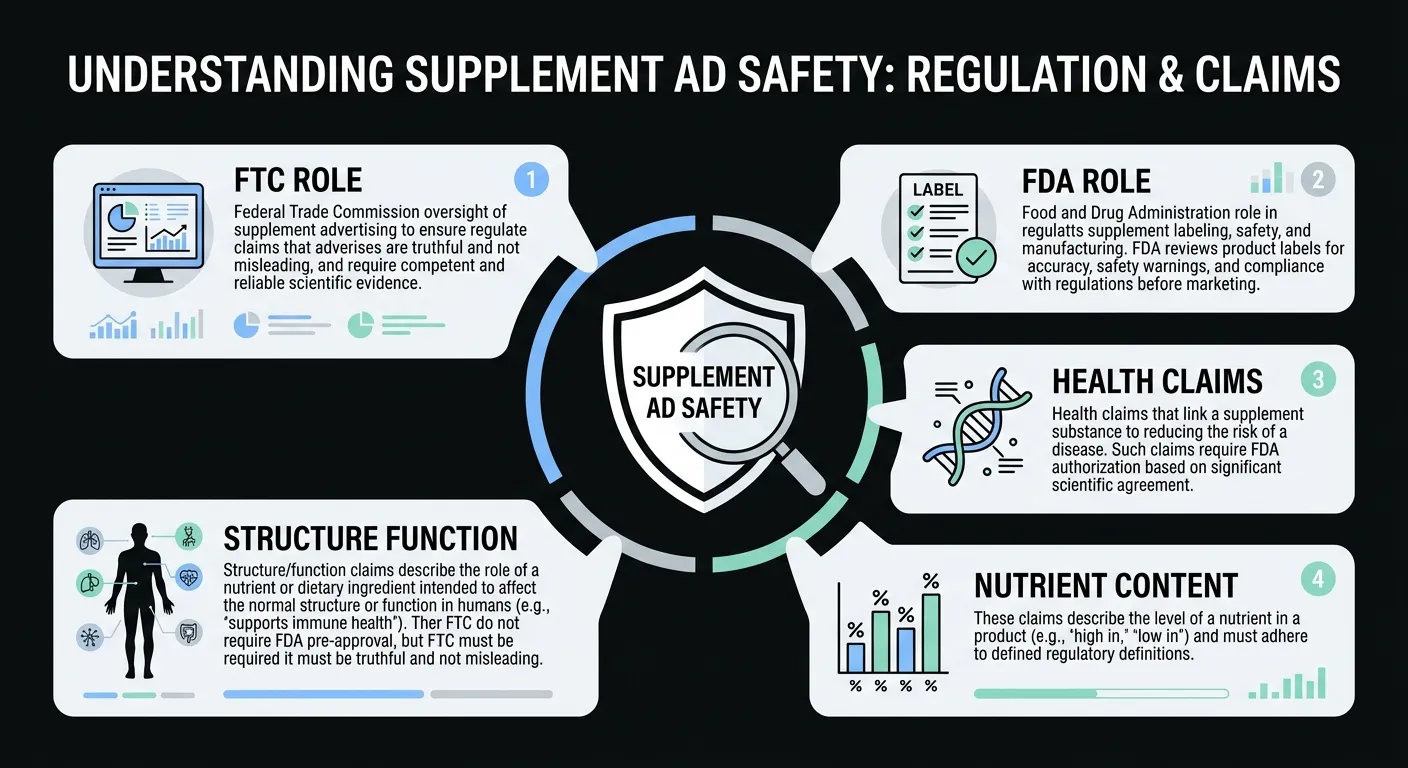
Establishing clear legal definitions is the primary way of defending consumers against deceptive marketing in the wellness industry. Under the Federal Trade Commission Act, the government mandates that all health-product claims remain truthful and substantiated by reliable scientific evidence. Any promotional material failing to meet these standards faces scrutiny from both agencies. The law is strict.
- Truthfulness: All assertions regarding a product’s efficacy must be factual and never misleading to the average consumer.
- Substantiation: Companies must possess reliable scientific data to support every health-related claim before the advertisement is published.
- Jurisdiction: The Food and Drug Administration primarily oversees product labeling, whereas the FTC monitors the broader advertising landscape.
The three categories of regulated supplement claims
Statutory guidelines sort every promotional assertion into one of three distinct regulatory categories, determining the level of oversight required. These classifications dictate whether a manufacturer must seek pre-market approval or simply provide a notification to the government.
- Health-related assertions
- These describe a relationship between a nutrient and a reduced risk of a disease, requiring significant scientific agreement and pre-approval.
- Nutrient content claims
- These characterize the level of a nutrient in a product using terms like “high” or “low” based on established daily values.
- Structure/function claims
- These focus on how a nutrient impacts the normal operation of the human body without mentioning specific diseases.
FDA Modernization Act of 1997 and authorized health claims
Distinguishing pre-approved scientific consensus from unverified marketing hype became easier following major legislative updates in the late nineties. The FDA Modernization Act of 1997 streamlined how certain statements reach the public by allowing an authoritative-statement notification route.
“The Food and Drug Administration Modernization Act of 1997 was signed into law… to add an authoritative-statement notification route for health claims and nutrient content claims.”
This law allows companies to bypass the lengthy pre-approval process if a scientific body of the US government has published a formal statement about the nutrient. It helps ensure consumers receive accurate information while maintaining a faster path to market for legitimate products. The balance is delicate. It involves protecting consumers without stifling innovation in the supplement industry.
How FTC and FDA divide jurisdiction over supplement ads?
While their missions overlap, the two bodies maintain a formal liaison agreement — defining which agency takes the lead on specific violations — to prevent redundant enforcement and ensure no deceptive practice goes unpunished. The Food and Drug Administration focuses its resources on the physical product: ingredients, safety, and the text on the bottle’s label. The FTC handles outward-facing marketing, such as social media posts, television commercials, and website banners.
How to recognize misleading language in supplement advertisements?
Advertisers exploit loopholes the law has not yet closed. Spotting a supplement advertising scam requires you to look past flashy graphics and focus on the subtle phrasing used to mislead you. Advertisers frequently use indirect references to illnesses or omit essential safety information to create a false sense of security. You can better protect yourself once you know what to look for.
- Vague health promises that imply a cure without naming a specific disease.
- Omission of potential side effects or interactions with common medications.
- Testimonials that do not comply with the Guides Concerning the Use of Endorsements and Testimonials in Advertising.
Signs a supplement company may not be legitimate
A manufacturer’s regulatory history serves as a documented indicator of past deceptive practices, making it as critical to evaluate as the ingredients themselves. Investigating a company’s record of compliance and the authenticity of their feedback is essential, as some businesses employ sophisticated digital tactics to artificially inflate their reputation and bypass consumer protections.
| Feature | Legitimate Company | Illegitimate Company |
|---|---|---|
| Customer Feedback | Organic and verified reviews. | Uses review hijacking to steal ratings. |
| Regulatory History | Clear of recent FTC or FDA orders. | History of enforcement for deceptive acts. |
| Transparency | Provides clear contact and lab data. | Hides behind vague third-party claims. |
A prominent manufacturer, The Bountiful Company, recently faced a $600,000 penalty after the FTC challenged their use of manipulated product listings on Amazon (1). This case highlights why you can’t always trust a high star rating at face value. Verify the source.
Spotting inflated nutrient content claims
Evaluating the front of a package requires knowing regulatory benchmarks. You can determine if a claim is exaggerated by comparing the stated nutrient levels against the Reference Daily Intake. Federal standards are specific about which descriptive terms a company may use.
- Locate the “Supplement Facts” panel to find the percentage of the daily reference value.
- Verify if the nutrient meets the 20% threshold required to be labeled as an “excellent source” or “rich” in that substance (2).
- Check if any label claiming to be a “high” source actually contains at least 20% of the daily value.
- Ensure that any claim of being a “good source” provides at least 10% to 19% of the daily value.
Labels that use these terms without meeting the percentage requirements mislead consumers.
Deceptive tactics: indirect disease references and omissions
Advertisements often skirt the rules by suggesting a product can treat a condition without using the disease’s name. These tactics rely on your ability to connect a physiological effect to a specific ailment. If a label mentions it “inhibits platelet aggregation,” it may be promoting a stroke prevention benefit without authorization.
- If the claim describes a physiological effect (e.g., “reduces cholesterol”):
- Check if it is linked to a specific disease like cardiovascular disease.
- If linked, it is likely an unauthorized health claim.
- If the advertisement omits the “FDA Disclaimer”:
- The product is likely making illegal claims.
Omissions are as dangerous as false statements. When a company fails to mention that a substance could interfere with heart medication, they’re putting your safety at risk. Identifying these gaps is essential for protecting vulnerable consumers.
Health risks and vulnerable consumers targeted by false claims
Deceptive marketing practices often exploit individuals facing life-altering diagnoses or chronic pain. These consumers are particularly susceptible to predatory claims because they are frequently searching for relief that conventional treatments may not fully provide. The stakes are high. To address the resulting safety risks, the Dietary Supplement and Nonprescription Drug Consumer Protection Act mandates that manufacturers report serious adverse events to the FDA within 15 business days (3). This legal framework highlights the inherent dangers when unregulated products enter the market with unsubstantiated promises.
- Elderly populations: Targeted with claims regarding cognitive decline or mobility restoration.
- Chronic illness patients: Marketed toward as a way to avoid the side effects of prescription medications.
- Financial risk: Vulnerable groups often divert limited resources away from proven medical care.
Why conditions like cancer and joint pain are most exploited?
Emotional desperation and the physical burden of long-term illness create a significant opening for unscrupulous sellers. When a person is managing a terminal diagnosis or debilitating joint pain, the promise of a natural alternative can feel like a necessary lifeline. Recent enforcement actions have targeted companies selling cannabidiol products that claimed to treat heart disease, Alzheimer’s, and hypertension without scientific evidence. These oncological and inflammatory conditions are prioritized by scammers because the high stakes make consumers less likely to question the evidence presented.
Falsehoods are dangerous. By diverting patients from established protocols for malignant growths, these companies delay life-saving interventions — often resulting in irreversible health declines that could have been managed through standard clinical care.
Why supplement scams persist despite regulatory oversight?
Scale remains the primary obstacle for those attempting to police the industry. With a domestic market that some estimates value at over $60 billion, the sheer volume of products makes comprehensive monitoring nearly impossible for federal agencies (4). There are currently as many as 95,000 distinct items on shelves, yet no systematic requirement exists for manufacturers to notify the government before introducing a new product. This lack of pre-market approval creates a reactive rather than proactive environment, leaving regulators struggling to keep pace with the influx of new entries.
“The agency is at a disadvantage because we do not have a full registry of what is on the market or what these products actually contain at any given time.”
- Rapidly changing product formulations that bypass static databases.
- The absence of a mandatory product listing requirement for all manufacturers.
- Limited resources to track thousands of new entries launched annually.
The vastness of this sector ensures that many unlawful products remain available for years before a regulatory oversight body can intervene. Understanding these systemic gaps is the first step in protecting yourself from fraud — and knowing which companies have already faced formal warnings is the next.
How to verify enforcement actions against supplement companies?
Verifying whether a manufacturer has faced legal scrutiny provides a clearer picture of their commitment to truth in advertising. Over the last decade, the Federal Trade Commission has filed numerous cases challenging health claims made for supplements (5). These regulatory interventions are public records — revealing which brands have historically misled consumers. You can actively check these archives to identify patterns of non-compliance before making a purchase.
| Agency | Primary Focus | Public Record Type |
|---|---|---|
| Federal Trade Commission | Deceptive marketing and unsubstantiated claims | Case archives and press releases |
| Food and Drug Administration | Product safety, labeling, and unapproved drugs | Warning letters and database entries |
Where to find FTC and FDA enforcement records?
Searching for specific regulatory history requires navigating two distinct federal portals. The Food and Drug Administration maintains a specialized digital repository listing unapproved products subject to health-fraud-related violations. It identifies supplements with hidden drug ingredients or illegal disease-treatment claims. A vital public safeguard.
- Health Fraud Product Database
- An FDA-managed list identifying products sold with deceptive claims or dangerous undeclared ingredients.
- FTC Case Proceedings
- A searchable archive of legal complaints and settlements involving companies that used false advertising to sell health products.
National Advertising Division: voluntary review vs formal enforcement
Comparing industry self-regulation with government oversight reveals the different layers of accountability in the marketplace. While federal agencies wield legal power, the National Advertising Division provides a forum for the prompt, voluntary discontinuance of misleading or unsubstantiated advertising claims. This process allows for faster resolution of disputes between competitors or consumer advocates. It relies on cooperation rather than subpoenas.
| Voluntary Review (Self-Regulation) | Formal Enforcement (Government) |
|---|---|
| Faster resolution of advertising disputes without litigation. | Lengthy legal processes that can take years to conclude. |
| No legal power to issue fines or seize products. | Authority to impose heavy financial penalties and injunctions. |
When NAD non-compliance triggers FTC referral?
Ignoring the recommendations of a self-regulatory body often leads to more severe legal consequences. If an advertiser does not comply with guidance provided during a voluntary review, the offending claims can be referred to the Federal Trade Commission for formal investigation. This transition marks the end of industry cooperation and the beginning of potential litigation. It is a serious escalation.
- Refusal to participate: A company declines to provide substantiation for its claims during the initial review process.
- Failure to modify: The manufacturer agrees with the findings but refuses to change the deceptive marketing materials.
- Federal petition: The case is formally handed over to the Federal Trade Commission for a mandatory investigation.
Checking these records is a strong defense — but you also have the power to initiate these processes yourself.
How to report false supplement advertising and exercise your rights?
Taking action against deceptive health claims is a powerful way to protect yourself and others from predatory marketing. Consumer reports can trigger investigations and lead to enforcement actions against fraudulent supplement companies. By using official channels like ReportFraud.ftc.gov, you can ensure that federal regulators are aware of misleading promises. The steps are straightforward.
- Identify the specific deceptive claim and the platform where you encountered it.
- Visit the official federal reporting site to document the incident.
- Provide details regarding any financial loss or health concerns through the Safety Reporting Portal.
Step-by-step: filing a complaint with the FTC or FDA
The reporting process involves completing a digital form on the agency website and does not require legal representation. To submit a report, users must provide the company name and the specific URL or physical location where the promotion was encountered.
- Navigate to the federal fraud reporting website and select the option to begin a new report.
- Describe the deceptive claim in your own words, including what the ad promised versus the reality you experienced.
- Submit the form to receive a unique report number, which allows you to track the status of your submission.
- Follow the next-step tips provided by the agency to see if further action is required on your part.
If the product caused an adverse reaction, notify the FDA as well. Use the Safety Reporting Portal for health-related complaints.
Consumer rights and recourse against deceptive advertisers
Federal agencies have the authority to freeze assets and force companies to return money to those they misled. In one major case, regulators secured over $1.1 million for more than 30,000 people who bought supplements falsely marketed for pain relief (6).
- Right to Truthful Advertising
- The legal requirement that all health claims must be substantiated by competent and reliable scientific evidence.
- Financial Recourse
- The ability to receive money back through agency-led settlements when a company is found guilty of deceptive practices.
- Triggering Investigations
- The power of a single consumer report to initiate a broader federal inquiry into a brand’s marketing history.
These protections are robust within the United States. The landscape changes significantly, however, when looking at how other regions manage health claims — and comparing those frameworks offers a useful benchmark for evaluating transparency and safety globally.
International regulatory frameworks: EU rules on supplement claims
Europe and America diverge sharply on dietary supplement regulation. While the United States relies heavily on post-market surveillance, European laws prohibit any suggestion that a food supplement can prevent, treat, or cure a human disease under Directive 2002/46/EC and Regulation (EC) No 1924/2006 (7). This fundamental ban ensures that products remain classified as foods rather than unapproved medicines. Rigorous standards apply here. Only specific health claims formally authorized by the European Food Safety Authority and added to the official European Commission register may appear on packaging or in marketing materials.
| Regulatory Attribute | European Union (EU) | United States (US) |
|---|---|---|
| Primary Claim Standard | Pre-market authorization required for all health claims. | Notification required; no pre-market approval for structure/function claims. |
| Disease Claims | Strictly prohibited under Directive 2000/13/EC. | Prohibited, but often appearing as “implied” claims before enforcement. |
| Scientific Review Body | European Food Safety Authority evaluates all evidence. | Manufacturer is responsible for substantiation; FDA reviews post-market. |
| Permitted Registry | Centralized European Commission list of approved claims. | No centralized “approved” list for structure/function claims. |
Despite these stringent legal barriers, compliance remains a significant challenge across member states. A detailed analysis of 437 radio advertisements in Spain during 2017 highlighted a systemic gap between law and practice (8). The study found that 80.3% of function claims and 20.4% of disease claims lacked the necessary authorization from the European Food Safety Authority or relevant regulations. Observing how the European Commission maintains these high standards gives American consumers a valuable benchmark for evaluating the transparency and safety of health products globally.
Sources
- Federal Trade Commission. Press release, “FTC Approves Final Order against The Bountiful Company in….
https://www.ftc.gov/news-events/news/press-releases/2023/04/ftc-approves-final-order-against-bountiful-company-first-case-alleging-hijacking-online-product - Electronic Code of Federal Regulations. 21 CFR 101.
https://www.ecfr.gov/current/title-21/chapter-I/subchapter-B/part-101/subpart-D/section-101.54 - uscode.house.gov.
https://uscode.house.gov/view.xhtml?req=%28title%3A21+section%3A379aa-1+edition%3Aprelim%29 - FDA. Q&A with FDA podcast transcript, “FDA’s Regulation of Dietary Supplements….
https://www.fda.gov/drugs/news-events-human-drugs/fdas-regulation-dietary-supplements-dr-cara-welch - Federal Trade Commission. Topic page, “Health Claims”.
https://www.ftc.gov/news-events/topics/truth-advertising/health-claims - Federal Trade Commission. Press release, “FTC Sends Refunds to Consumers Who….
https://www.ftc.gov/news-events/news/press-releases/2021/10/ftc-sends-refunds-consumers-who-bought-deceptively-marketed-supplements-treat-pain-age-related - eur-lex.europa.eu. EUR-Lex, Directive 2002/46/EC on food supplements (2000).
https://eur-lex.europa.eu/eli/dir/2002/46 - PubMed. Abstract for “False and misleading health-related claims in food supplements… (2017).
https://pubmed.ncbi.nlm.nih.gov/33972003/
F.A.Q
How can I tell if a supplement advertisement is a scam?
Be alert for vague health claims, promises to cure diseases without scientific evidence, or ads that leave out important safety information. Scams use misleading language and exploit health concerns.
Who regulates supplement advertising in the United States?
The Federal Trade Commission (FTC) ensures ads are truthful, while the Food and Drug Administration (FDA) oversees product safety and labeling.
What makes a supplement ad illegal or deceptive?
A supplement ad violates the law if it makes unproven health claims, misleads consumers, or lacks solid scientific backing.
What should I do if I think I’ve found a scam supplement ad?
To report an ad, use the federal fraud reporting website and include the company name and where it appeared. For health problems, submit a report through the FDA Safety Reporting Portal.
Can I get my money back if I bought a supplement based on a false claim?
Federal agencies have the authority to order companies to refund consumers if found guilty of deceptive advertising.
How do US supplement advertising rules compare to Europe?
In the US, most claims require notification and are reviewed after products reach the market. In Europe, all health claims need approval before sale, and disease treatment claims are not permitted.
What types of claims are allowed in supplement advertising?
Claims must be accurate and fall into one of three categories: health claims requiring pre-approval, nutrient content claims, or structure/function claims that don’t mention specific diseases.
