


A shopper browsing the vitamin aisle might notice a label claiming a product is “FDA approved,” and wonder if that bottle has undergone the same rigorous testing as a prescription medication. In the United States, FDA approval of dietary supplements is a term often misunderstood by consumers because the agency treats these products differently than pharmaceutical drugs. The Food and Drug Administration maintains oversight of the industry, yet it lacks the legal authority to verify the safety or effectiveness of a supplement before it reaches store shelves. In practice, this means that unlike prescription drugs, a consumer cannot assume a supplement’s efficacy has been independently validated prior to purchase.
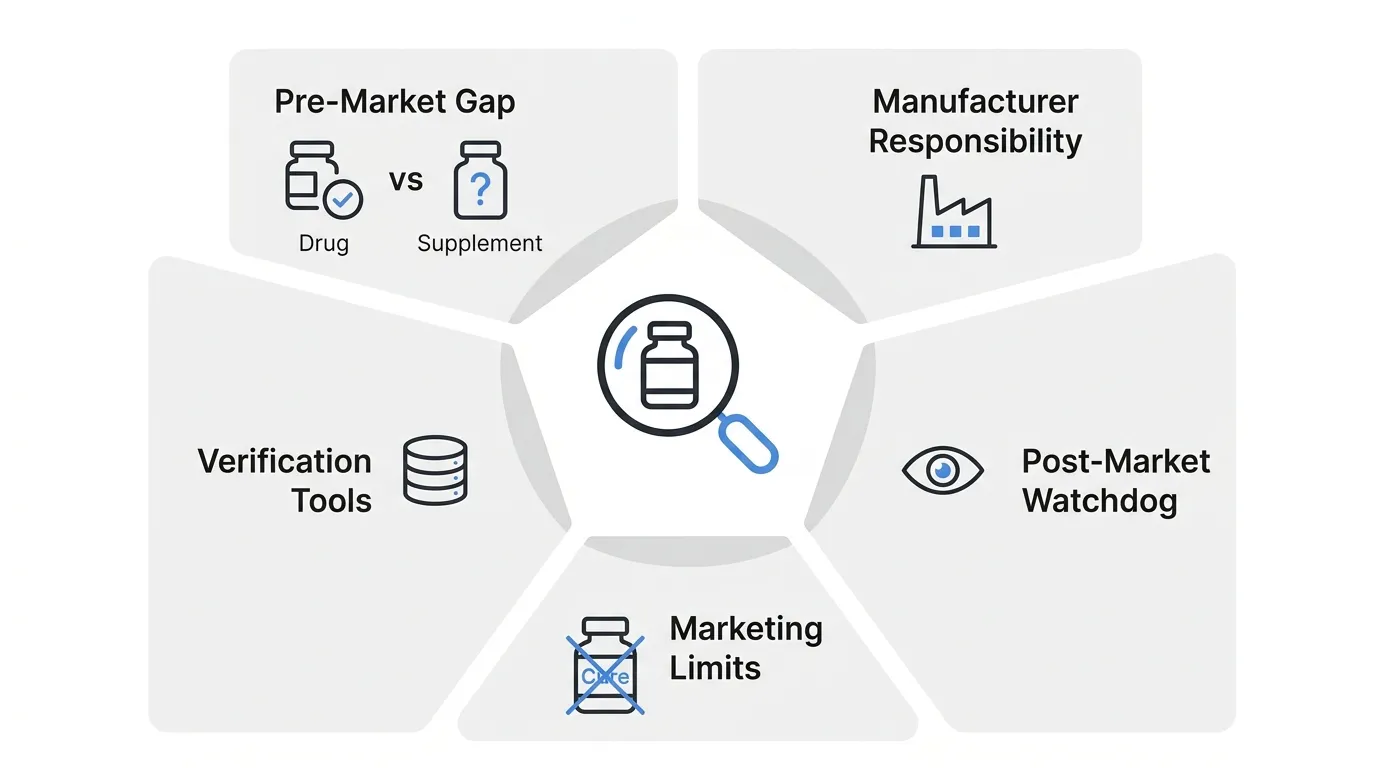
The regulatory landscape changed significantly when Congress passed the Dietary Supplement Health and Education Act of 1994. This law placed responsibility squarely on manufacturers to ensure their own products are safe before sale, shifting the agency’s role from pre-market gatekeeper to post-market watchdog.
As a result, the Food and Drug Administration focuses its resources on monitoring adverse event reports and correcting misleading labeling after a product is already in your cabinet. Understanding the Dietary Supplement Health and Education Act of 1994 explains why the “approved” seal you expect may not exist in the way you imagine.
What ‘FDA approved’ actually means for dietary supplements?
Regulatory authority under the Federal Food, Drug, and Cosmetic Act does not grant the agency power to verify the safety, efficacy, or labeling of dietary supplements before they reach consumers. Manufacturers are therefore not required to provide evidence of a product’s benefits to the government prior to retail distribution. Instead, the Human Foods Program’s Office of Food Chemical Safety, Dietary Supplements, and Innovation serves as the central hub for coordinating federal oversight — monitoring these products only once they are already on the market.
Supplements vs. drugs: the pre-market approval gap
Prescription medications and dietary supplements follow entirely different paths to the consumer. The Center for Drug Evaluation and Research requires extensive clinical data to prove a drug is safe and effective for its intended use before it can be legally sold. Consider Epidiolex, a cannabidiol oral solution that the agency evaluated and granted FDA approved status specifically to treat seizures associated with certain syndromes (1). That level of pre-market scrutiny never applies to supplements.
- Clinical validation: Drugs must undergo multi-phase clinical trials to prove efficacy, whereas supplements do not require any pre-market testing for effectiveness.
- Restricted compounds: Certain substances like cannabidiol and tetrahydrocannabinol are legally excluded from the supplement definition under the Federal Food, Drug, and Cosmetic Act because they were first investigated as new drugs.
- Marketing limits: Supplement manufacturers cannot claim their products treat or cure diseases, a privilege reserved for products that have passed the full drug approval process.
A drug is considered unsafe until proven otherwise. A supplement is generally presumed safe until the government proves it causes harm.
How to check whether a supplement is truly FDA approved?
Verifying the status of your vitamins or herbal extracts requires a proactive approach, because the “approved” label is often misused in marketing. Official digital resources let you see what the government actually knows about a specific product. Use them.
- Consult the Dietary Supplement Label Database maintained by the NIH to view over 200,000 labels and compare ingredients across different brands (2).
- Search the Health Fraud Product Database to identify products that have been the subject of agency warnings or public notifications.
- Remember that a manufacturer’s claim of being an “FDA-registered facility” only means they have notified the agency of their location; it does not imply any product endorsement.
Facility inspections are routine. They carry no implication of approval for the specific pills or powders produced within those walls.
NIH Office of Dietary Supplements guidance on regulatory status
The NIH Office of Dietary Supplements provides a framework for understanding how health products are categorized based on their intended use — a classification that dictates which rules a manufacturer must follow.
“Whether a product is classified as a dietary supplement, conventional food, or drug is based on its intended use, most often as shown by the manufacturer’s product label or accompanying literature.”
Many consumers look for seals from the United States Pharmacopeia or other independent groups to ensure quality. Organizations like ConsumerLab.com and NSF provide valuable testing for purity and potency, but their certification is a private service — not a substitute for federal approval. These third-party evaluations focus on whether the contents match the label, not on whether the product is effective for a specific health condition. Knowing that boundary clarifies who is responsible for what is inside your supplement bottle, and how the government intervenes when safety issues arise.
Who is responsible for supplement safety – and what the FDA can actually do?
Manufacturers must adhere to Current Good Manufacturing Practices (cGMP) as outlined in 21 CFR Part 111, which mandates rigorous testing for identity, purity, and strength. Despite these requirements, FDA inspection data frequently reveals gaps in compliance; for instance, nearly 50% of inspected facilities receive Form 483 observations for failing to establish proper ingredient specifications. While the industry is legally bound to self-verify product safety, the government primarily acts through post-market surveillance, intervening only after adverse event reports or laboratory audits signal a public health risk.
- Product Integrity: Private firms must validate the safety of all ingredients and the accuracy of every label claim before retail distribution begins.
- Regulatory Standards: Any entity that manufactures, packages, labels, or holds these products is legally bound by Current Good Manufacturing Practices to maintain consistency and purity.
Manufacturer obligations under DSHEA
Establishing uniform quality standards became a priority following the 2007 publication of the final rule for 21 CFR Part 111, which addressed widespread issues with heavy metal contamination and ingredient mislabeling. This federal framework dictates exactly how facilities must manage production and storage (3). These Current Good Manufacturing Practices set the mandatory baseline for operational hygiene and documentation. Every domestic and international facility supplying goods to the American market must strictly adhere to these protocols to ensure consumer protection and product integrity.
- Facility Compliance
- Establishments must maintain clean environments and detailed records to prevent contamination or mix-ups during the production cycle.
- Verification Audits
- Federal agents conduct periodic site visits to inspect manufacturing equipment and review labeling accuracy against actual batch contents.
New Dietary Ingredient Notification process explained
Unlike the rigorous clinical trials required for pharmaceutical products, the New Dietary Ingredient Notification Process serves as a specific safety gate for modern additives. Any substance not sold in the United States prior to October 15, 1994 is classified as a new ingredient (4), and firms must submit a safety dossier to federal regulators at least 75 days before the product hits shelves. This window allows for a brief review of the manufacturer’s evidence.
FDA’s post-market monitoring and enforcement powers
Action against a specific product often occurs only after it has reached the public and demonstrated a clear risk to health. The government intervened to ban dietary aids containing ephedrine alkaloids in early 2004, for instance, after determining they posed an unreasonable risk of illness or injury (5). This reactive stance allows the agency to target specific threats as they emerge, functioning as a post-market watchdog with limited oversight resources. When a product is found to be adulterated or misbranded, federal authorities can remove it from circulation through several legal channels.
- Prohibited Substances: The agency has officially declared ingredients like 1,3-DMAA, DMHA, and phenibut as illegal or adulterated for use in these products.
- Legal Recourse: Regulators can initiate seizures of physical inventory or seek court-ordered injunctions to stop a firm from continuing its operations.
These enforcement actions confirm the government’s role as a secondary safety net rather than a primary gatekeeper. Because the agency lacks the resources to monitor every label, some brands attempt to exploit consumer trust by using official logos or language that implies a level of government endorsement that does not exist.
Misleading ‘FDA approved’ claims: how they happen and why they matter
According to an HHS OIG report, nearly 20% of dietary supplement labels failed to include the mandatory disclaimer stating that the product had not been evaluated by the FDA (6). When companies omit these required disclosures or use misleading language, they undermine the safety framework that DSHEA was designed to provide. Such deceptive practices often involve the misuse of technical identifiers to create an unearned aura of legitimacy. These tactics force buyers to verify safety entirely on their own.
- NDC misuse: The National Drug Code Directory explicitly states that an assigned NDC number does not denote agency approval.
- Illegal representation: Using these codes to imply a product is federally vetted violates federal law.
- Consumer risk: False claims can lead individuals to rely on unproven substances for serious health conditions instead of seeking validated treatments.
Facility registration vs. product approval: a common confusion
Marketing materials often showcase official-looking seals to suggest a product has been vetted, when in reality the company has simply completed a routine administrative requirement. Most domestic and foreign entities that handle food or supplements must complete a facility registration to operate legally. This process tells the agency where products are made. It does not involve any evaluation of a specific supplement’s safety or efficacy.
Registration is a mandatory baseline for transparency, not a badge of quality — a procedural step that enables inspections rather than a pre-market endorsement of the ingredients inside the bottle.
When a supplement claim crosses into drug territory?
Promising to “cure” or “treat” a specific disease instantly transforms a supplement into an unapproved drug in the eyes of regulators. To maintain legal status, a product must include a clear statement of identity and follow strict labeling protocols. Ignore those boundaries, and the product is considered misbranded and subject to immediate enforcement action.
“The law requires five specific label elements: a statement of identity, net quantity, nutrition labeling, an ingredient list, and the manufacturer’s contact information. Deviating from these standards or adding therapeutic claims violates the legal definition of a dietary supplement.”
Safety monitoring also relies on accurate labeling. Every product must provide a domestic address or phone number so consumers can report adverse events, and the responsible party is then legally obligated to submit any serious reports to federal authorities within 15 business days (7).
FDA warning letters targeting false approval claims
Federal regulators actively monitor the marketplace and issue formal notices when they identify blatant deceptions regarding product status. A Warning Letter is an official notification that a company is in violation of the law and must take corrective action. These documents are public, providing a paper trail against brands that prioritize marketing over legal compliance.
- Baker’s Best Health Products: This company received a notice because their marketing materials claimed a product was made in an “FDA-approved lab,” which constitutes misbranding.
- Misbranding consequences: Making any false claim about federal approval can lead to product seizures, injunctions, or criminal prosecution under the FD&C Act.
These letters prove that “approved labs” do not exist in the way many marketers suggest. The agency inspects facilities for compliance but never grants an “approved” status to the building itself.
FTC and FDA joint action on deceptive supplement advertising
Protecting the public from predatory health claims requires a coordinated effort between multiple government branches. The Federal Trade Commission monitors the truthfulness of advertising across websites, social media, and print. One agency focuses on the physical label and safety. The other ensures that promotional “hype” does not mislead the average buyer.
On February 5, 2019, the Federal Trade Commission and health regulators issued joint warnings to several entities, including Pure Nootropics, LLC (8), targeting companies making unproven claims about treating Alzheimer’s disease and other incurable conditions. By working together, these agencies can more effectively penalize firms that use deceptive tactics — and keep the language used to describe a product’s benefits within the bounds of scientific evidence.
Understanding health claims on supplement labels
Three distinct categories of claims exist on supplement packaging, each with a different evidentiary bar. Navigating the complex regulatory landscape established by the Nutrition Labeling and Education Act of 1990 and the Food and Drug Administration Modernization Act of 1997 is essential to understanding them. These legal frameworks dictate how manufacturers communicate product benefits while maintaining a clear distinction from the rigorous testing required for pharmaceuticals. The categories differ significantly in their evidentiary standards and the precise wording required on the label.
| Claim Type | Regulatory Requirement | FDA Oversight |
|---|---|---|
| Authorized Health Claim | Significant Scientific Agreement (SSA) standard. | Requires premarket review and authorization. |
| Qualified Health Claim | Credible but not conclusive scientific evidence. | Requires a specific qualifying disclaimer. |
| Structure/Function Claim | Must be truthful and not relate to disease. | Notification only; requires a mandatory disclaimer. |
Authorized health claims vs. qualified health claims
The distinction between these two claim types depends entirely on the strength of the scientific consensus supporting the substance-disease relationship. An authorized health claim meets the highest standard—known as Significant Scientific Agreement—which allows for definitive statements regarding risk reduction. A label may state, for example, that adequate calcium and vitamin D throughout life may reduce the risk of osteoporosis under 21 CFR 101.72 (9). These claims are strictly vetted by regulators before the product ever reaches the shelf.
- Authorized Health Claim
- A statement reviewed by the FDA that describes a relationship between a food or supplement ingredient and a reduced risk of a disease, such as the link between plant sterol esters and coronary heart disease.
- Qualified Health Claim
- A claim supported by emerging scientific evidence that does not yet meet the SSA standard, such as certain claims regarding selenium and specific cancers, requiring language that clarifies the level of evidence.
Evidence levels dictate the wording. Authorized claims use direct language; a qualified health claim must include a disclaimer to ensure the reader is not misled about the certainty of the science.
Structure/function claims and their disclaimer requirement
Describing how a nutrient affects the human body is fundamentally different from claiming disease prevention. A structure/function claim describes the role of a nutrient intended to affect the normal structure or function in humans — “calcium builds strong bones” being the classic example. Unlike health claims, these do not undergo a premarket approval process. Instead, the manufacturer ensures the claim is truthful and must notify the agency within 30 days of first marketing the product (10), placing the burden of substantiation directly on the company.
This mandatory notification ensures the public understands the supplement is not a replacement for medical intervention.
Warning signs that a supplement’s regulatory claims are false
Verify that any product making health claims includes the mandatory FDA disclaimer, as its absence often signals illegal marketing for serious medical conditions. Some manufacturers bypass regulations by using red-flag phrases that imply their formulas function as medicine, such as promising to “relieve crushing chest pain” or “eliminate arthritis inflammation.” Because supplements are legally prohibited from claiming to treat, cure, or prevent specific diseases, these implied medical promises are a clear indicator of an unregulated and potentially dangerous product.
You should also watch for FTC-targeted deceptions: promises of rapid weight loss, or claims that a formula is “scientifically proven” without any actual evidence to back them up.
- Implied claims regarding the relief of bronchospasm or asthma symptoms.
- Assertions that a product can treat specific conditions like rheumatoid arthritis or angina.
- Unsubstantiated marketing terms like “clinically proven” or “guaranteed weight loss.”
Red-flag phrases to watch for on labels and ads
Protect yourself by learning to spot the linguistic tricks used in health fraud. When you see terms like “miracle cure” or “new discovery,” your internal alarm should sound immediately. Classic tip-offs. Fraudulent marketers often promise “guaranteed results” or boast about a “secret ingredient” to draw you in. Be especially wary of cancer-related promises — claims that a product “treats all forms of cancer” or “miraculously kills cancer cells and tumors” are both dangerous and false.
- “Shrinks malignant tumors” or “selectively kills cancer cells.”
- “More effective than chemotherapy.”
- “Attacks cancer cells, leaving healthy cells intact.”
- “Cures cancer.”
Safety risks: interactions, adverse effects, and misuse
Mixing supplements with medication can lead to severe health complications. Even natural products carry real risks. Vitamin K, for instance, can interfere with the blood-thinning effects of warfarin. St. John’s wort is another common offender — it speeds up the breakdown of antidepressants, birth control pills, and heart medications. Data suggests thousands of emergency department visits and hospitalizations occur annually due to supplement-related issues.
| Supplement Ingredient | Potential Interaction or Risk |
|---|---|
| Vitamin K | Reduces the effectiveness of warfarin in preventing blood clots. |
| St. John’s Wort | Speeds breakdown of anti-HIV drugs and transplant medications. |
| Weight Loss/Energy | Higher statistical correlation with emergency department visits. |
When to stop taking a supplement and report to the FDA?
If your body reacts poorly to any product, discontinue use immediately. Watch for serious adverse events — itching, blood in the urine, sudden fainting, severe abdominal pain, or shortness of breath — and seek medical care right away if symptoms worsen. Reporting these issues through the manufacturer’s official channels or the Safety Reporting Portal helps protect others and documents quality defects. Contact the manufacturer’s documentation line for support.
- If you experience itching or loss of appetite:
- Discontinue use and monitor symptoms.
- If you experience fainting, cognitive changes, or blood in the urine:
- Seek immediate medical attention and report the incident to the Safety Reporting Portal.
How to evaluate a supplement label and report problems?
Carefully examining the packaging before you buy is your best defense against misleading marketing. Always look for a Supplement Facts label — a mandatory feature on every dietary supplement sold. This standardized panel provides a clear breakdown of the product’s ingredients and nutritional profile. It is your primary tool for verifying exactly what you are putting into your body.
Because these products can contain a vast array of substances — from common vitamins and minerals to complex herbs, amino acids, enzymes, and probiotics — the label serves as a vital map for your health. You can use this information to cross-reference the red-flag phrases discussed previously and confirm the product is legitimate.
- Locate the Supplement Facts label on the back or side of the container.
- Verify that all active ingredients, including botanical extracts and probiotic strains, are clearly listed.
- Check for the manufacturer’s contact information to ensure accountability.
Reading the Supplement Facts panel for compliance signals
Start at the top of the Supplement Facts panel: the serving size. This value is not arbitrary — it represents the maximum amount recommended for a single eating occasion. If directions suggest taking one to three capsules with a meal, the serving size must account for all three. You’ll then know the exact potency of your highest possible dose.
- Identify the serving size to understand the concentration of the ingredients per dose.
- Look for proprietary blends, which must display their total weight on a single line.
- Check the list of ingredients within those blends, as they must appear in descending order of weight.
Proprietary blends protect a company’s formula, but they must still follow strict transparency rules. You will see the total blend weight first, followed by specific components listed from most to least prevalent. This hierarchy helps you estimate whether a specific herb is present in a meaningful amount or just a trace quantity.
Reporting an adverse event through FDA MedWatch
Report serious supplement side effects immediately through the FDA Safety Reporting Portal or MedWatch. The FDA has noted that consumer adverse event reports are a primary mechanism for identifying safety signals in the supplement market, helping the government track patterns of harm and take action against dangerous products. By documenting incidents electronically, you contribute to a collective safety database that protects other consumers from similar risks.
- Visit the official safety reporting portal to begin the electronic filing process.
- Provide specific details about the supplement, including the brand name and the symptoms you experienced.
- Submit the form to ensure your case is reviewed by safety evaluators.
The legal framework for this process was established by the Dietary Supplement and Nonprescription Drug Consumer Protection Act, which mandates that manufacturers and the public have a defined pathway to report serious health issues. By participating in this system, you help uphold the standards this legislation was intended to create.
Background: DSHEA, the supplement market, and why the rules are what they are
In 1994, the American supplement market consisted of approximately 4,000 products, a figure that surged to more than 85,000 distinct items by 2014 (11). Currently, 150 million people in the United States consume these products, with 79% of that group reporting daily use. Even among elite populations, the prevalence remains high—most Finnish Olympic athletes studied by Heikkinen et al. utilize at least one supplement during their training cycles (12). This widespread adoption and staggering market growth make the legal framework governing these products a matter of significant public interest.
The Dietary Supplement Health and Education Act of 1994 (DSHEA) defines dietary supplements as a category of food, which fundamentally alters how they are monitored compared to pharmaceutical products. Under this law, the manufacturer is responsible for ensuring safety, but the FDA does not approve these products before they reach the consumer.
The legislative intent behind the Dietary Supplement Health and Education Act of 1994 was to balance consumer access with safety monitoring. It shifted the burden of proof — requiring the government to demonstrate that a product is unsafe, rather than requiring the maker to prove it is effective before sale. Because the market lacks pre-market vetting, understanding the limits of federal oversight is the only way to navigate modern health claims safely.
Sources
- FDA. -approved prescribing information for EPIDIOLEX (cannabidiol) oral solution.
https://www.accessdata.fda.gov/drugsatfda_docs/label/2026/210365s024s029s030lbl.pdf - NIH. Office of Dietary Supplements page for the Dietary Supplement Label Database.
https://ods.od.nih.gov/Research/Dietary_Supplement_Label_Database/ - Electronic Code of Federal Regulations. 21 CFR Part 111.
https://www.ecfr.gov/current/title-21/chapter-I/subchapter-B/part-111 - uscode.house.gov. U (1994).
https://uscode.house.gov/view.xhtml?req=granuleid:USC-prelim-title21-section350b - FDA. Information on Select Dietary Supplement Ingredients and Other Substances (2004).
https://www.fda.gov/food/dietary-supplements/information-select-dietary-supplement-ingredients-and-other-substances - oig.hhs.gov. HHS Office of Inspector General report, Dietary Supplements:….
https://oig.hhs.gov/reports/all/2012/dietary-supplements-structurefunction-claims-fail-to-meet-federal-requirements/ - uscode.house.gov. U.
https://uscode.house.gov/view.xhtml?req=(title:21%20section:379aa-1%20edition:prelim) - FDA. /FTC warning letter to Pure Nootropics, LLC, dated February 5, 2019 (2019).
https://www.ftc.gov/system/files/attachments/press-releases/ftc-fda-send-warning-letters-companies-selling-dietary-supplements-claiming-treat-alzheimers-disease/pure_nootropics_llc_warning_letter_wl_565425.pdf - Electronic Code of Federal Regulations. 21 CFR § 101.
https://www.ecfr.gov/current/title-21/chapter-I/subchapter-B/part-101/subpart-E/section-101.72 - FDA. Notifications for Structure/Function and Related Claims in Dietary….
https://www.fda.gov/food/information-industry-dietary-supplements/notifications-structurefunction-and-related-claims-dietary-supplement-labeling - pmc.ncbi.nlm.nih.gov. Ranjani R (1994).
https://pmc.ncbi.nlm.nih.gov/articles/PMC4330859/ - link.springer.com. Heikkinen et al.
https://link.springer.com/article/10.1186/1550-2783-8-1
F.A.Q
Are dietary supplements FDA approved like prescription drugs?
No, dietary supplements aren’t FDA approved like prescription drugs. The FDA doesn’t review supplements for safety or effectiveness before they’re sold.
What does it mean if a supplement says ‘FDA approved’ on the label?
Claims that a supplement is ‘FDA approved’ are misleading. The FDA does not approve dietary supplements before they reach the market.
How does the FDA regulate dietary supplements?
After supplements are on the market, the FDA monitors them for side effects and addresses misleading labels, but does not check for safety or effectiveness before sale.
Who is responsible for making sure supplements are safe?
Manufacturers are responsible for ensuring their supplements are safe before selling them to consumers.
Can supplement manufacturers claim their products treat or cure diseases?
No, supplement manufacturers can’t claim their products treat or cure diseases. Only products that complete the full drug approval process can make those claims.
How can I check if a supplement has FDA approval or warnings?
The Dietary Supplement Label Database from the NIH and the Health Fraud Product Database list products that have received FDA warnings or notifications.
What should I do if I experience side effects from a supplement?
Serious side effects from a supplement should be reported through the FDA Safety Reporting Portal or MedWatch. Reporting helps track and address safety problems.
