


Finding a brand you can actually trust feels nearly impossible when every bottle on the shelf makes the same bold promises. A crowded marketplace where flashy labels often mask questionable quality makes the task overwhelming. A Dietary Supplement is simply a product you take to add nutritional value to your diet, typically containing ingredients like minerals, amino acids, or Probiotics. These formulations come in various delivery methods, ranging from standard tablets and capsules to versatile powders or liquids. While they might look like pharmaceutical products, the FDA oversees them under a specific legal framework established in 1994 that treats them as a subcategory of food (1).
Navigating this landscape means looking beyond the marketing claims on the front of the package. The federal government does not pre-approve these products for safety before they hit the market, so independent verification becomes your best tool for clarity. Organizations such as USP and NSF International step in to fill that gap, verifying that what is listed on the label matches what’s inside the bottle. They provide an objective seal of approval regarding manufacturing standards and the purity of the contents. Given that the FDA lacks pre-approval authority, you need to know exactly what separates a reliable manufacturer from one that is merely cutting corners.
What makes a supplement brand trustworthy?
Shoppers in a crowded pharmacy aisle often struggle to distinguish between a rigorous laboratory-backed product and a bottle filled with unverified fillers. Under the Dietary Supplement Health and Education Act of 1994, the regulatory landscape shifted, placing the burden of vetting product integrity and label accuracy squarely on the firms that produce them (2). These entities must operate within the legal boundaries established by the Federal Food, Drug, and Cosmetic Act, which governs how products are presented to the public. Trust is not a default setting in this industry.
- Transparency: Openly sharing sourcing data and internal testing protocols.
- Regulatory Compliance: Adhering to federal labeling requirements and safety reporting.
- Quality Control: Implementing rigorous checks to prevent contamination or potency errors.
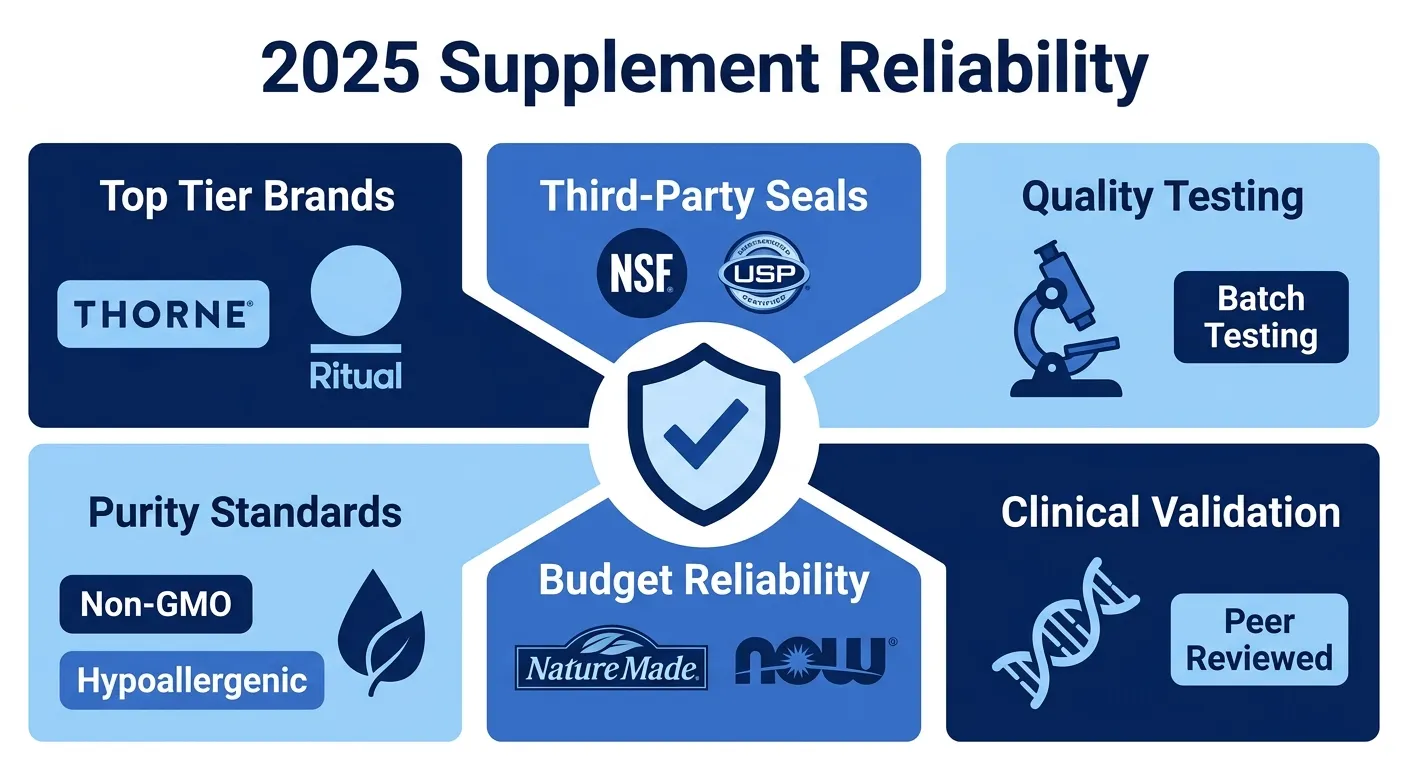
Industry leaders like Thorne exemplify this commitment by moving beyond basic regulatory compliance to secure rigorous third-party certifications. By obtaining the NSF Certified for Sport® designation, these manufacturers provide transparent validation that their products are free from over 280 banned substances and meet exacting purity standards.
Why FDA pre-market approval doesn’t apply to supplements?
Most consumers assume every pill on a store shelf has undergone rigorous federal testing for efficacy. It hasn’t. In reality, the agency lacks the legal authority to verify the safety or performance of dietary supplements before they reach the consumer, which creates a significant oversight gap. Because there is no mandatory registration process for every new formulation, the government often remains unaware of a product’s specific chemical makeup until an adverse event is reported — making it an inherently reactive system. The agency currently lacks a comprehensive, real-time database to track every new ingredient or formulation as it enters the retail market.
How CGMP compliance and ingredient sourcing signal accountability?
The most accountable manufacturers treat federal minimums as a floor rather than a ceiling. By following Current Good Manufacturing Practice guidelines, companies ensure that their facilities maintain strict hygiene and documentation standards to prevent batch-to-batch variation. NOW Foods, for instance, maintains its own analytical laboratories where staff perform roughly 31,000 monthly evaluations to confirm the identity and purity of their materials (3). That level of internal scrutiny goes far beyond basic legal mandates.
- Current Good Manufacturing Practice
- A system of federally monitored regulations designed to ensure products are consistently manufactured to specific quality standards.
- Ingredient sourcing
- The process of identifying and verifying the origin and purity of raw materials before they are used in production.
While NOW Foods demonstrates the power of internal testing through 31,000 monthly evaluations, the most transparent brands supplement these efforts with independent third-party certification. This external validation from organizations like USP and NSF International provides an objective layer of scrutiny that confirms internal quality controls are functioning as intended.
Third-party certifications that verify supplement quality
How many supplement labels actually match what’s inside the bottle? Independent validation serves as a critical filter in a market where label claims are not verified by federal authorities. Brand-level trust signals provide a baseline, but rigorous third-party certification from organizations like USP, NSF International, UL Solutions, and the Banned Substances Control Group adds a genuinely objective layer of scrutiny. These entities operate as impartial auditors, authenticating the product itself.
Retail environments are increasingly mandating these standards to protect their customers. CVS Pharmacy requires all vitamins and supplements sold in its stores to undergo independent testing; Amazon updated its dietary supplement requirements on April 2, 2024, to necessitate third-party verification for products listed on its platform (4). These policies shift the burden of proof from the buyer to the manufacturer. This scrutiny is vital given that a JAMA study found 89% of analyzed supplements did not accurately list ingredients, making certification details essential reading before any purchase.
USP and NSF International: what their seals guarantee
A recognized seal on a bottle means the product has met specific, rigorous benchmarks for purity and potency. The USP Dietary Supplement Verification Program involves a comprehensive manufacturing facility audit, a thorough review of quality control documentation, and laboratory testing of the finished product. These steps confirm the supplement dissolves as intended and contains no harmful contaminants. Nature Made became the first USP-verified vitamin and supplement brand in 2002 and maintains its participation today (5).
Athletes often require even more specialized oversight to avoid accidental doping violations. The NSF Certified for Sport program is specifically recognized by the U.S. Anti-Doping Agency, Major League Baseball, and the National Hockey League (6), and it screens for over 280 substances banned by major athletic organizations (7). That level of transparency is vital for professional competitors.
- USP Verified Mark
- Guarantees the product contains the ingredients listed on the label in the declared potency and was manufactured under sanitary, well-controlled conditions.
- NSF Certified for Sport
- Ensures the supplement is free from substances prohibited by major sports leagues and that the manufacturing facility undergoes semi-annual audits.
ConsumerLab and Labdoor: independent testing and rankings
Discrepancies between advertised benefits and actual chemical composition are frequently caught by labs that operate outside the manufacturer’s payroll. ConsumerLab and Labdoor function as independent watchdogs, purchasing products directly from retail shelves to test for label accuracy and purity. Their data reflects how products perform in the real world, not in a controlled corporate setting.
ConsumerLab has tested more than 6,100 products from over 1,000 brands since its inception in 1999 (8). Labdoor takes a different approach, calculating a Quality score based on label accuracy, purity, nutritional value, ingredient safety, and efficacy — then ranking supplements by both Quality and Value to help consumers optimize their spending.
- If you prioritize long-term historical data and volume:
- consult ConsumerLab reports to see how a brand has performed across decades of testing.
- If you want a data-driven ranking of the best current options:
- review Labdoor’s Quality and Value scores to compare specific ingredient safety and projected efficacy.
According to research by Cohen et al. and data from Labdoor, selecting products that lack these independent seals significantly increases the statistical likelihood of ingesting heavy metals or hidden fillers.
Risks of low-quality and unregulated supplement brands
Unregulated supplements can cause permanent organ damage or death. Consumers face severe physiological consequences when they ingest products containing hidden pharmacological agents or toxic botanical residues. Certain supplement ingredients exert potent biological activity that may trigger adverse events or interfere with prescribed medications. Because of the regulatory gap described above, the FDA can only designate a product as adulterated or misbranded after it has already reached retail shelves — a reactive posture that means public safety often depends on identifying harm after it occurs.
- Ingredient potency: Bioactive compounds in these formulas can significantly alter metabolic processes or clash with pharmaceutical treatments.
- Post-market enforcement: The FDA identifies and removes dangerous items only after they are available to the public.
- Historical bans: Regulators have previously prohibited Ephedrine alkaloids due to unreasonable safety risks and forced the removal of Comfrey from internal-use products.
Third-party certification helps mitigate these dangers, yet the underlying systemic risks remain significant for those who overlook such safeguards — often leading to adulteration and contamination. Understanding the specific ways these products fail safety standards is the next step in protecting your health.
Adulteration, contamination, and mislabeled ingredients
Testing reveals that 89% of botanical sports supplements containing prohibited stimulants are inaccurately labeled, highlighting a pervasive lack of quality control in this specific market segment [1] (9). This widespread contamination often involves prohibited substances never disclosed to the buyer. Worse still, 40% of these products do not even contain detectable amounts of the primary ingredient listed on the bottle [1].
- Undeclared pharmaceuticals: A study by Kumar et al. published in JAMA Network Open identified 776 adulterated dietary supplements, finding that 97.7% of these products contained hidden drug ingredients that were not disclosed on the labels [2] (10).
- Toxic heavy metals: Analyses frequently detect lead, arsenic, or cadmium in botanical extracts due to poor sourcing or manufacturing.
- Ingredient substitution: High-cost herbs are often replaced with cheaper, less effective, or potentially harmful fillers.
These discrepancies demonstrate that what appears on the packaging rarely reflects the actual chemical composition of the contents. Such failures in transparency place an immense burden on the consumer to verify every purchase — and they raise serious concerns about supplement-drug interactions.
Supplement-drug interactions and surgical dangers
Patients undergoing elective procedures have suffered life-threatening complications because they failed to disclose their use of common herbal extracts. These interactions alter how the body processes drugs, either rendering them ineffective or dangerously amplifying their potency. St. John’s wort, for example, speeds up the breakdown of many drugs, while vitamin K can directly counteract blood-thinning treatments [3] (11). The American Society of Anesthesiologists warns that garlic and ginseng can increase bleeding risks during surgery, and that kava and valerian may dangerously prolong the sedative effects of anesthesia — necessitating their cessation well before any scheduled operation.
Clinicians must be informed of all self-prescribed regimens to prevent these avoidable medical errors, a point often highlighted in FDA warning letters. Awareness of how these substances behave in a clinical setting is a vital component of patient safety.
FDA warning letters and misleading health claims
Official correspondence serves as a critical indicator that a manufacturer has failed to meet basic safety or transparency obligations. A warning letter is issued when the agency identifies significant violations — manufacturing processes that do not meet quality standards, or the inclusion of adulterated ingredients. These documents provide a public record of companies that prioritize profit over consumer protection.
“Health claims on dietary supplements are evaluated through an evidence-based review system, with procedures for qualified health claims.”
Yet many brands continue to market their products using unverified promises. Stay skeptical of any product that suggests it can treat or cure specific diseases without rigorous evidence. Evaluating these red flags allows for a more informed approach to selecting safe and effective products.
How to evaluate a supplement brand’s trustworthiness?
Protecting your health requires a systematic process to verify product integrity, beginning with the foundational safety standards established by the NIH and Mayo Clinic. These organizations recommend thoroughly investigating a supplement’s intended benefits and proper dosing protocols before making a purchase. Within the United States, the Office of Food Chemical Safety, Dietary Supplements, and Innovation oversees this regulatory landscape to ensure manufacturers adhere to essential quality frameworks. Evaluating these safety profiles helps consumers navigate the complex marketplace with greater confidence and scientific oversight.
- Consult expert frameworks: Use the four-question approach recommended by major health institutions to assess risks and benefits.
- Cross-reference ingredients: Utilize the NIH Dietary Supplement Label Database to compare specific nutrient levels against government-recommended amounts.
NIH and Mayo Clinic guidance on choosing safe brands
Marketing language deserves careful scrutiny. Treat terms like “verified” or “standardized” with healthy skepticism — they do not always ensure consistent product quality. Transparency matters most. A brand’s genuine commitment to consumer safety shows through clear labeling that states every component in the formula. Demand complete disclosure.
Avoid any product that lists a proprietary blend without disclosing the exact amounts of each ingredient. The Mayo Clinic warns that these hidden formulations make it impossible to know exactly what you are consuming — a significant red flag for potential safety issues. By choosing brands that provide full disclosure, you ensure your regimen aligns with the evidence-based standards discussed previously regarding health risks.
How to check a brand’s FDA warning letter history?
Checking a company’s regulatory track record is a straightforward way to see if they have a history of safety violations. You can access public records to see whether a manufacturer has received formal notices regarding their production or labeling practices.
- Navigate to the official government search tool for regulatory correspondence.
- Enter the brand name into the keyword search field to pull up relevant records.
- Filter the results by date or specific subject matter to narrow down the history.
- Look for a response or a formal notice from the Warning Letter Close-Out Letter Program.
A closeout letter is particularly meaningful. It indicates that the agency has verified the company’s corrective actions.
Red flags in supplement marketing and labeling
Transparency in the manufacturing process is what separates top-tier companies from those simply looking for a quick sale. Look for third-party validations that go beyond basic legal requirements. These certifications often involve rigorous testing for contaminants like heavy metals or pesticides. Not all distinctions are equal, though.
- Purity Award
- A distinction given to products that rank in the top third of their category for cleanliness after being tested for various toxins.
- Certified B Corporation
- A status held by brands like Ritual that indicates a high level of social and environmental transparency, including the public sharing of ingredient sources.
How to read and verify a Supplement Facts label?
Look closely at the % Daily Value (%DV) to understand how a single serving fits into your overall nutritional needs. This percentage tells you the concentration of a nutrient relative to standard dietary recommendations. According to federal guidelines, a value of 5% or less is considered low, while 20% or more is considered high (12). That simple metric helps you avoid over-supplementing or wasting money on under-dosed products.
- Locate the %DV column to identify nutrient density.
- Check the ingredients list for the presence of a proprietary blend.
- Verify if the label lists individual weights for every dietary ingredient.
When a Supplement Facts label uses a blend, it may only show the total weight of the mixture. That obscures the actual dose of the most important components.
Most trustworthy vitamin company: what the evidence shows
Independent evaluations provide the most objective data for choosing where to spend your money. Reports from organizations like ConsumerLab and Healthline show which brands consistently meet their label claims, aggregating data from thousands of consumers and laboratory tests to rank performance across the industry. High-performing brands often include Nature Made, Thorne, Nordic Naturals, and Garden of Life.
Other frequently recommended names under these rigorous standards are NOW Foods, Life Extension, and Kirkland Signature. Modern brands like Ritual and Pure Encapsulations also appear regularly in top-tier rankings for their focus on ingredient traceability and third-party certifications. While brand reputation serves as a common starting point for consumers, these specific options are primarily noted for their transparent sourcing and rigorous testing protocols. Evaluating these industry benchmarks prepares you to analyze how pricing structures actually relate to the verified efficacy of herbal formulations.
Price, quality, and special considerations for herbal brands
Does a premium price tag ensure a superior herbal supplement, or are consumers simply paying for marketing? Research from ConsumerLab suggests cost is a poor proxy for purity or potency. In a review of 27 multivitamin products, seven failed laboratory testing despite daily costs ranging from $0.03 to $1.00 (13) — and several of the high-cost items were among those that fell short of basic standards. Shoppers should remain skeptical of any assumed correlation between expense and efficacy.
| Factor | Advantages of Premium Brands | Advantages of Store Brands |
|---|---|---|
| Cost Efficiency | Often invest more in proprietary research. | Retailer versions frequently match national brand quality at a fraction of the price. |
| Testing Transparency | May provide more detailed third-party certificates. | Consumer Reports testing shows high reliability for budget options like Costco’s Kirkland Signature. |
Budget-friendly options often exceed expectations. Data from Consumer Reports indicates that private-label products frequently provide the same nutritional value as expensive alternatives. Certain warehouse club multivitamins cost $0.05 or less per day while meeting all label claims. That reality shifts the focus from the price tag to the specific regulatory and botanical standards that govern how these plants are processed.
Does price reliably predict supplement quality?
Research into the supplement marketplace consistently reveals a disconnect between what consumers pay and the chemical integrity of the product. Studies examining green tea, ashwagandha, and creatine have shown that expensive formulations do not reliably contain higher levels of active compounds. A laboratory study published in the Journal of the American Pharmacists Association analyzed 26 green tea supplements and found a remarkably low correlation between daily cost and essential quality markers like catechin levels or antioxidant activity (14).
“The daily cost of a supplement is not an indicator of its quality, as products with lower price points often meet or exceed the phenolic content and antioxidant capacity of their more expensive counterparts.”
Price is deceptive. Many affordable brands maintain rigorous manufacturing standards that rival luxury labels. Selecting a supplement based on cost-per-serving may lead to unnecessary spending with no measurable gain in health benefits or ingredient concentration.
Extra trust criteria for botanical and herbal brands
Verifying the integrity of a plant-based extract requires looking beyond the front label to the technical specifications of the ingredient. Unlike synthetic vitamins, herbal products are susceptible to natural variation and intentional substitution. Federal regulations under 21 CFR 101.4(h)(1) mandate that manufacturers clearly identify the specific plant part used — root, leaf, or stem — because different parts of the same plant can harbor vastly different concentrations of bioactive compounds.
- Labeling transparency: Labels must use standardized botanical naming and specify the exact plant part to ensure the consumer receives the intended therapeutic fraction.
- Adulteration safeguards: Participation in the Botanical Adulterants Prevention Program provides a framework for identifying fraudulent raw materials and ensuring the purity of essential oils and extracts.
The Botanical Adulterants Prevention Program plays a critical role in the industry by developing methods to spot “spiked” or diluted ingredients. By utilizing these rigorous authentication protocols, brands can protect consumers from contaminated or ineffective botanical supplies.
Supplements vs. pharmaceuticals: a regulatory comparison
A critical distinction separates quality standards from the clinical validation required for drugs. While medications undergo rigorous pre-market approval to prove safety and efficacy, products containing Vitamin D, Calcium, or Fiber are generally presumed safe until proven otherwise. This fundamental difference in oversight shifts the burden of proof from the manufacturer to the regulator once the product is available to the public. Understanding these categories is vital for safety.
| Feature | Dietary Supplement | Pharmaceutical |
|---|---|---|
| Legal Category | Regulated as food | Regulated as a drug |
| Pre-market Approval | Not required for most products | Mandatory clinical trials |
| Claims Allowed | Structure/function claims only | Disease treatment and prevention |
Navigating this regulatory landscape requires consumers to distinguish between Good Manufacturing Practices (CGMP), which ensure consistency and purity, and the clinical efficacy trials mandatory for pharmaceuticals. Rather than assuming therapeutic equivalence, buyers should verify if a manufacturer has submitted a New Dietary Ingredient Notification for novel components. This proactive scrutiny remains the most effective safeguard against products that bypass rigorous pre-market safety assessments.
New Dietary Ingredient notifications as a trust signal
Ensuring that novel components are evaluated before they reach retail shelves is a cornerstone of modern consumer protection. A New Dietary Ingredient Notification is a formal communication where manufacturers provide evidence to the government regarding the safety of a substance not marketed before 1994. It is a vital mechanism for transparency. Beyond general filings, the government frequently issues specific ingredient policies to address emerging risks or legal status.
N-acetyl-L-cysteine and vinpocetine, for instance, have undergone extensive safety reviews and policy updates to clarify their standing in the marketplace. These reviews demonstrate that while the system is not pre-approval based, active monitoring of high-profile ingredients persists. By tracking these notifications, stakeholders can better identify which products adhere to the highest transparency standards currently available in the industry.
How to report adverse events via FDA MedWatch?
Public safety relies heavily on individuals and clinicians who identify and document unexpected reactions to health products. When a problem occurs, stakeholders can use the MedWatch system to ensure the government is informed of potential hazards. This voluntary reporting serves as an early warning system for the entire community. Reports are integrated into the FDA Adverse Event Reporting System (FAERS) database, which remains publicly searchable for researchers and consumers.
- Access the Safety Reporting Portal online to initiate a formal documentation of the event.
- Select the option for a private citizen or healthcare provider to submit a voluntary report regarding a human product.
- Complete the necessary details on Form FDA 3500 for professionals or Form FDA 3500B designed for consumers.
- Submit the information through the portal, or alternatively, send the documentation via mail, fax, or a dedicated phone line.
Sources
- fda.gov. U (1994).
https://www.fda.gov/food/information-consumers-using-dietary-supplements/questions-and-answers-dietary-supplements - fda.gov. U (1994).
https://www.fda.gov/food/dietary-supplements - nowfoods.com. NOW Foods, Our Manufacturing Process.
https://www.nowfoods.com/quality-safety/our-manufacturing-process - Amazon Seller Central Forum. Announcement, Changes to dietary supplements policy (2024).
https://sellercentral.amazon.com/seller-forums/discussions/t/c23c51e6-159c-4d01-b297-9836d7d16419 - Nature Made. Our History (2002).
https://www.naturemade.com/pages/our-history - Major League Baseball. Press release on Nutrafol and NSF Certified for Sport.
https://www.mlb.com/amp/press-release/press-release-nutrafol-becomes-first-and-only-hair-growth-supplement-brand-to-earn-nsf-certified-for-sport-enters-multi-year-partnership-with-major-league-baseball.html - nsf.org. NSF, Certified for Sport Program.
https://www.nsf.org/consumer-resources/articles/certified-for-sport-program - consumerlab.com. About ConsumerLab (1999).
https://www.consumerlab.com/about/ - pmc.ncbi.nlm.nih.gov. Cohen et al.
https://pmc.ncbi.nlm.nih.gov/articles/PMC10352857/ - jamanetwork.com. Kumar et al.
https://jamanetwork.com/journals/jamanetworkopen/fullarticle/2706496/ - NIH. National Center for Complementary and Integrative Health, How Medications….
https://www.nccih.nih.gov/health/know-science/how-medications-and-supplements-can-interact/some-supplements-may-decrease-the-effects-of-medications - fda.gov. U.
https://www.fda.gov/food/nutrition-facts-label/daily-value-nutrition-and-supplement-facts-labels - consumerlab.com. News release, Best and Worst Multivitamins According to ConsumerLab, Nearly….
https://www.consumerlab.com/news/best-and-worst-multivitamins/05-25-2023/ - sciencedirect.com. Evaluation of cost versus antioxidant determinants in green tea dietary….
https://www.sciencedirect.com/science/article/abs/pii/S1544319115300820
F.A.Q
How can I tell if a supplement brand is trustworthy?
Look for brands that clearly state their ingredient sources, follow strict manufacturing standards, and hold third-party certifications such as USP or NSF International.
Why is third-party certification important when choosing supplements?
Third-party certifications verify that the label matches the contents and confirm the product meets high standards for purity and quality.
What does CGMP mean on a supplement label?
CGMP stands for Current Good Manufacturing Practice, meaning the company follows strict federal rules to maintain product quality and consistency.
Are all supplements tested by the FDA before they are sold?
No, the FDA doesn’t pre-approve supplements for safety or effectiveness before they’re sold, making independent checks important.
Which supplement brands are known for strong quality control?
Thorne and NOW Foods are recognized for strong quality control, thorough internal testing, and earning third-party certifications.
How do I report a bad reaction to a supplement?
Adverse events can be reported through the FDA MedWatch system online or by submitting Form FDA 3500B as a consumer.
What makes ingredient sourcing important in supplements?
Proper ingredient sourcing keeps raw materials pure and safe, prevents contamination, and ensures the supplement delivers as promised.
